Loading...

Scalable Logistics: The “Mass Move” Protocol

When a brand experience or a national advocacy tour scales to hundreds of attendees, the most significant operational risk to the program is rarely what happens on the stage—it is what happens between the airport and the hotel. The movement of human beings at scale introduces infinite variables: weather delays, traffic gridlock, lost luggage, and exhausted participants.


At TeamESI, managing the movement of hundreds of participants across dozens of cities requires an uncompromising, high-level operational oversight. Whether the mission involves housing a technical production crew of 50 or a high-net-worth donor delegation of 500, travel logistics are never treated as a simple administrative task. Logistics is the invisible engine of a successful campaign. If the logistics fail, the attendees arrive frustrated, and the messaging is lost before the keynote speaker even takes the microphone.

The Philosophy of the Master Manifest The foundation of a mass move is the Master Manifest. This document is the “Single Source of Truth” for the entire operation. It is not merely a static list of names and confirmation numbers; it is a living, breathing data set that tracks the real-time location and status of every single participant under the team’s care.

The manifest tracks commercial flight numbers, tail numbers and FBO (Fixed Base Operator) details for private aviation, dedicated ground transport assignments, and exact hotel room numbers in a single, integrated digital ecosystem. By maintaining this obsessive level of detail, the logistics team can anticipate problems before they escalate into crises. If a commercial flight from Atlanta is delayed by two hours due to weather, the ground transport team is notified automatically via flight-tracking software integrations. The team does not wait for the participant to call in a panic from the tarmac; the pickup is already rescheduled, and the hotel is notified that the guest’s “late arrival” is confirmed. This proactive, data-driven management is what separates an elite logistical firm from a standard travel agency.

Managing the Room Block: Strategy, Attrition, and Hierarchy Booking 500 hotel rooms is a simple transaction; managing them effectively is a science. When an operation spans multiple properties—often necessary because a single hotel cannot accommodate the entire group, or because security protocols require separating staff from VIP donors—the complexity grows exponentially.

The process begins months in advance by negotiating the hotel contracts with a strict focus on the client’s financial protection. “Attrition Clauses” (the financial penalty a client pays if they do not fill the contracted number of rooms) and “Cut-off Dates” are aggressively managed. The team performs a forensic “Weekly Audit” of the block, comparing the internal Master Manifest against the hotel’s generated “pickup report” to ensure that every single room is accounted for, preventing the client from paying for “ghost rooms” that went unassigned.

A “Block Hierarchy” strategy is also deployed. The core production team—the individuals working 16-hour days to build the show—are placed at the “Workhorse” property closest to the venue to minimize their commute time and maximize their sleep. Donors, C-suite executives, and high-level participants are placed in “Premium” properties that reflect the status and luxury of the brand.

The “Principal” Standard: Zero-Friction VIP Travel For high-profile talent, world leaders, or Fortune 100 “Principals,” the standard of travel must be absolutely frictionless. These individuals operate on incredibly tight schedules, and their mental energy must be completely reserved for their performance on stage.

To achieve this, “Advanced Arrival” protocols are coordinated. A dedicated logistical lead is physically present at the airport gate or the private terminal before the Principal’s aircraft arrives. The “Greeter Flow” is perfectly mapped. The Principal is met immediately, escorted past the public, and moved directly into a pre-staged, climate-controlled vehicle.

Simultaneously, the team coordinates with the hotel management to execute a “Pre-Keyed” check-in. The Principal never stands in a line at a front desk, and they never hand over a credit card for incidentals. They are escorted from the black car, straight to the elevator, and directly into their suite, where their luggage has already been delivered and unpacked if requested. This “tarmac-to-suite” transition is a hallmark of executive production. The team absorbs the friction of travel so the talent can focus entirely on delivering the message.

Staff and Crew Logistics: Protecting the Engine Room While VIPs receive “white glove” treatment, the technical production crew requires “efficiency and endurance” logistics. Moving a crew of 50 to 100 people involves strictly managing labor laws and travel time mandates. Travel schedules are built to rigorously respect the “10-hour rest” rule. If a crew is pushing through a grueling 14-hour load-in that ends at 2:00 AM, it is a safety imperative that their hotel is within a highly efficient radius to maximize their physical recovery time.

Crew logistics also involve clear, concise communication. Upon landing, every staffer receives a digital “Travel Briefing” that includes their exact ground transport details, a map to the production office location, their meal schedule, and a 24-hour emergency contact for the Logistical Command Desk. By stripping the “logistical noise” and guesswork out of the crew’s day, they are empowered to focus entirely on the highly technical, dangerous work of building the show. A well-rested, fully informed crew is the foundation of a safe, flawless event.

The Last Mile Challenge: Commanding Ground Transport The most common point of operational failure in large-scale logistics is the “Last Mile”—the physical movement of the masses from the hotel to the venue. When 500 people must be seated in a ballroom by precisely 9:00 AM, relying on ride-sharing apps or local taxis is an unacceptable risk that will guarantee a delayed start.

This movement is commanded through “Dedicated Shuttles” operating on meticulously timed “Looping Schedules.” The transportation grid is managed with military precision. Site Leads track the “Headcount” in real-time at every hotel loading zone. If a 50-passenger shuttle reaches capacity, the Site Lead communicates via radio to the staging lot to release the next vehicle early, maintaining a continuous flow of movement.

Traffic logistics are physically mapped in advance. The routes are driven by the team at the exact time of day the move will occur to account for local rush-hour traffic patterns. If an advocacy campaign involves a high-profile motorcade or a multi-bus tour, the team coordinates directly with local law enforcement to secure road closures or arrange police escorts. Travel times are never guessed; they are verified through physical rehearsal.

Command Center and Technological Tracking In modern logistics, total visibility is required. GPS tracking hardware is deployed across the shuttle fleets, integrating directly into the “Mobile Manifest” applications used by the Site Leads. If a VIP donor asks a team member where their designated transport is, the team member can look at their tablet and provide exact, real-time data, eliminating anxiety and projecting total control.

Automated SMS protocols are also leveraged. Participants receive a “Welcome” text upon landing containing their driver’s name, vehicle type, and license plate number. “Departure” reminders are pushed to their phones the night before they leave, confirming their exact lobby call time. This strategic use of technology drastically reduces the volume of panicked phone calls to the production office and ensures a smoother, more premium experience for the guest. Technology is utilized to humanize and streamline the logistics, not to replace the critical element of personal hospitality.

Risk Mitigation: The “Plan B” Protocol In large-scale mass movement, anomalies will occur. Severe weather, mechanical failures, and human error are inevitable realities of travel. The competitive advantage lies in the depth of the “Contingency Planning.”

The logistical architecture always includes a “Buffer.” Extra rooms are held quietly in the block for emergency, last-minute additions. “Standby” luxury vehicles and reserve shuttles are kept in the motorpool, staged out of sight, ready to be deployed instantly for unexpected VIP arrivals or missed commercial connections.

The Logistics Command Center remains staffed 24/7 during major travel days. If a national advocacy tour is struck by a blizzard in the Midwest, the team is already rerouting the bus fleet, extending the current hotel contracts, and communicating the pivot to the attendees before the client even fully realizes the scope of the problem. The operation moves with a profound sense of urgency, yet maintains a spirit of absolute calm. The problem is solved behind the scenes, and the solution is presented to the client.

Conclusion: Logistics as a Form of Respect Ultimately, flawless logistics are a form of deep respect for the attendee’s time and the client’s investment. When a participant’s travel is seamless, they instinctively know the brand values them. When a principal’s suite is ready the exact second they walk through the door, they step onto the stage with an unshakeable confidence in the team behind them.

Elite logistical management is not simply “booking travel.” It is the architectural design of a human movement. By absorbing the complexity, the friction, and the exhaustion of the mass move, the production team ensures that the client’s focus remains exactly where it belongs: on winning the room.


The Fiber-Optic Safety Net: Mission-Critical Connectivity

In the high-stakes world of event-based communications, there is no greater operational gamble than relying on a shared internet connection. Production teams routinely walk into beautiful, multi-million-dollar venues where sales directors promise “high-speed, enterprise-grade Wi-Fi.” However, for an elite technical team, those words are an immediate red flag. When executing a national advocacy campaign, a medical device launch, or a global corporate broadcast, hoping the internet stays online is not a strategy. The infrastructure must be custom-built to ensure it cannot possibly go down.


Bandwidth is the oxygen of a modern live event. Without it, the event suffocates. Operating at the highest level requires treating data distribution with the exact same rigor as structural rigging or electrical engineering.

The Physics of the Bandwidth Crunch The reality of venue Wi-Fi is dictated by simple physics and network capacity. A building’s network might test at incredibly high speeds during a site survey when the ballroom is completely empty. However, as soon as five hundred to a thousand guests walk through the doors—each carrying a smartphone, a smartwatch, and a laptop—that “high-speed” connection is suddenly fractured and split a thousand ways. Access points become saturated, IP addresses are exhausted, and the network grinds to a halt.

At TeamESI, the philosophy is simple: bandwidth is never shared with the audience. During the initial technical audit, the team identifies the building’s Demarcation Point (the “Demarc”)—the exact physical location where the Internet Service Provider’s (ISP) fiber enters the facility. The objective is to pull a dedicated “Dry Pair” or a secondary, private circuit that is physically isolated from the hotel or convention center’s guest network. By building a private fiber-optic backbone that is entirely exclusive to the production team, the risk of a bandwidth crunch during a critical live moment is eliminated.

Diverse-Path Redundancy: The Power of the Failover In a professional production environment, a single point of failure is a non-starter. Even the highest-quality, dedicated fiber line can be accidentally severed by construction equipment in an alleyway three blocks from the venue. Because the external world cannot be controlled, the internal response must be flawless. This is where the principle of redundancy is applied.

A zero-downtime network is built by running a primary fiber line and a secondary, “diverse-path” connection. Diverse-path means the secondary line physically enters the building from a completely different direction, utilizing a different ISP if possible. If the primary line is compromised, the secondary line is already active.

Furthermore, the team utilizes “Bonded Cellular” technology as an impenetrable third-tier backup. Bonded cellular routers take multiple cellular data signals from different carriers (e.g., Verizon, AT&T, T-Mobile) and mathematically bond them together into a single, high-bandwidth data stream. If the venue experiences a catastrophic failure of its hardlines, the intelligent networking system automatically fails over to the cellular bond in milliseconds. The switch is so seamless that a global audience watching a 4K livestream will not drop a single frame of video. This layered approach is how a true zero-downtime environment is maintained.

Tactical Fiber and Hard-Wired Integrity Once the pristine data feed is secured inside the building, the focus shifts to how that data is transported from the network rack to the stage. For mission-critical show control, wireless links are aggressively avoided. While modern wireless technology is highly advanced, it remains subject to invisible interference—RF (Radio Frequency) noise generated by thousands of cell phones, local television stations, and even unshielded power cables.

To remove the variable of wireless interference, every critical station is hard-wired. The team runs Shielded CAT6 cable or Military-Grade Tactical Fiber to the broadcast encoders, the lighting consoles, the audio desks, and the teleprompter operators. Tactical fiber is encased in a Kevlar-reinforced jacket, designed to withstand being rolled over by heavy road cases or stepped on by a busy crew. By physically hard-wiring the infrastructure, the data is forced to move in a straight, protected line, completely insulated from the invisible chaos of the room’s airspace.

Subnetting, VLANs, and Traffic Control Inside the private production network, data is not simply lumped into one chaotic pool. High-end managed switches are utilized to create VLANs (Virtual Local Area Networks). VLANs allow the Network Engineer to digitally slice the physical network into separate, isolated channels.

This enables strict traffic prioritization through Quality of Service (QoS) protocols. The livestream video encoder is assigned the highest absolute priority on the network. The show-control systems (lighting and audio data) are assigned the second tier, followed by the production office internet, and finally, the dedicated media press riser. By subnetting the network, a “broadcast storm” or a minor technical glitch on a production assistant’s laptop is mathematically prevented from impacting the bandwidth required for the main stage. The health of every single ethernet port is monitored in real-time. If a specific device begins consuming an unusual amount of bandwidth, the Network Engineer can isolate or throttle that specific port instantly, protecting the integrity of the broader show.

Latency vs. Jitter: The Silent Killers of Live Video When amateurs discuss internet connections, they only ask about “speed” (bandwidth). However, in live video broadcasting, latency and jitter are the true enemies of a successful show. Latency is the delay in the signal from point A to point B. Jitter is the variation or inconsistency in that delay.

High jitter causes live video to stutter, drop frames, or “pixelate” into unreadable blocks. A network can have massive speed, but if it has high jitter, the broadcast will fail. The team utilizes specialized diagnostic equipment to measure the quality of the circuit, testing the stability of the packet delivery. The objective is to find the lowest-latency path to the streaming destination. If the building’s internal hardware introduces lag, the team bypasses the venue’s gateway entirely, utilizing proprietary, high-performance firewalls to create a direct-to-the-internet path that guarantees smooth, continuous video delivery.

Cybersecurity in a Live Environment A dedicated network is not just an investment in performance; it is a critical investment in security. When managing sensitive advocacy messaging, proprietary corporate product launches, or internal financial keynotes, risking a data breach on a public hotel network is an unacceptable liability.

By building private, encrypted VLANs, a digital perimeter is established. The production traffic is walled off from the rest of the world. Network Engineers monitor exactly who and what is connected to the network at any given millisecond. If a rogue device or an unauthorized user attempts to “hop” onto the production stream or access the teleprompter files, the system flags it, and the port is shut down instantly. In an era of digital espionage and data leaks, the network must be treated like a secure physical vault, ensuring that the only data leaving the room is the exact message the client intended to send.

The Role of the Dedicated Network Engineer To execute this level of sophistication, a dedicated Network Engineer is deployed on-site for major operations. This is not a general project manager who happens to be “tech-savvy”; this is a highly specialized professional who spends the entire duration of the build and the show monitoring the signal flow. They watch the bitrates, monitor the firewall logs, and ensure the connection stays perfectly healthy.

Having a dedicated human being commanding the network allows the rest of the production team (video, audio, lighting) to focus entirely on the creative and technical execution of the show. If a subtle issue arises with the ISP, the Network Engineer is already executing the failover protocol before the video director even notices a dropped frame. This proactive, “over-the-shoulder” approach is the operational standard required to guarantee a zero-failure environment.

Conclusion: The Invisible Safety Net At the end of the day, elite technical production is about acting as the invisible safety net for the client. The extra time, rigorous engineering, and specialized budget dedicated to fiber-optic backbones and redundant failovers are the price of professional certainty.

The team does not rely on luck, and the team certainly does not rely on venue Wi-Fi. A custom path is built for every single show. Whether it is a multi-city advocacy tour moving across the country or a high-stakes, one-night-only brand launch, the connection must be rock solid, the signal must be perfectly clean, and the message must be delivered with absolute, undeniable certainty. That is the standard of excellence required to win.

The Fiber-Optic Safety Net: Mission-Critical Connectivity

In the high-stakes world of event-based communications, there is no greater operational gamble than relying on a shared internet connection. Production teams routinely walk into beautiful, multi-million-dollar venues where sales directors promise “high-speed, enterprise-grade Wi-Fi.” However, for an elite technical team, those words are an immediate red flag. When executing a national advocacy campaign, a medical device launch, or a global corporate broadcast, hoping the internet stays online is not a strategy. The infrastructure must be custom-built to ensure it cannot possibly go down.


Bandwidth is the oxygen of a modern live event. Without it, the event suffocates. Operating at the highest level requires treating data distribution with the exact same rigor as structural rigging or electrical engineering.

The Physics of the Bandwidth Crunch The reality of venue Wi-Fi is dictated by simple physics and network capacity. A building’s network might test at incredibly high speeds during a site survey when the ballroom is completely empty. However, as soon as five hundred to a thousand guests walk through the doors—each carrying a smartphone, a smartwatch, and a laptop—that “high-speed” connection is suddenly fractured and split a thousand ways. Access points become saturated, IP addresses are exhausted, and the network grinds to a halt.

At TeamESI, the philosophy is simple: bandwidth is never shared with the audience. During the initial technical audit, the team identifies the building’s Demarcation Point (the “Demarc”)—the exact physical location where the Internet Service Provider’s (ISP) fiber enters the facility. The objective is to pull a dedicated “Dry Pair” or a secondary, private circuit that is physically isolated from the hotel or convention center’s guest network. By building a private fiber-optic backbone that is entirely exclusive to the production team, the risk of a bandwidth crunch during a critical live moment is eliminated.

Diverse-Path Redundancy: The Power of the Failover In a professional production environment, a single point of failure is a non-starter. Even the highest-quality, dedicated fiber line can be accidentally severed by construction equipment in an alleyway three blocks from the venue. Because the external world cannot be controlled, the internal response must be flawless. This is where the principle of redundancy is applied.

A zero-downtime network is built by running a primary fiber line and a secondary, “diverse-path” connection. Diverse-path means the secondary line physically enters the building from a completely different direction, utilizing a different ISP if possible. If the primary line is compromised, the secondary line is already active.

Furthermore, the team utilizes “Bonded Cellular” technology as an impenetrable third-tier backup. Bonded cellular routers take multiple cellular data signals from different carriers (e.g., Verizon, AT&T, T-Mobile) and mathematically bond them together into a single, high-bandwidth data stream. If the venue experiences a catastrophic failure of its hardlines, the intelligent networking system automatically fails over to the cellular bond in milliseconds. The switch is so seamless that a global audience watching a 4K livestream will not drop a single frame of video. This layered approach is how a true zero-downtime environment is maintained.

Tactical Fiber and Hard-Wired Integrity Once the pristine data feed is secured inside the building, the focus shifts to how that data is transported from the network rack to the stage. For mission-critical show control, wireless links are aggressively avoided. While modern wireless technology is highly advanced, it remains subject to invisible interference—RF (Radio Frequency) noise generated by thousands of cell phones, local television stations, and even unshielded power cables.

To remove the variable of wireless interference, every critical station is hard-wired. The team runs Shielded CAT6 cable or Military-Grade Tactical Fiber to the broadcast encoders, the lighting consoles, the audio desks, and the teleprompter operators. Tactical fiber is encased in a Kevlar-reinforced jacket, designed to withstand being rolled over by heavy road cases or stepped on by a busy crew. By physically hard-wiring the infrastructure, the data is forced to move in a straight, protected line, completely insulated from the invisible chaos of the room’s airspace.

Subnetting, VLANs, and Traffic Control Inside the private production network, data is not simply lumped into one chaotic pool. High-end managed switches are utilized to create VLANs (Virtual Local Area Networks). VLANs allow the Network Engineer to digitally slice the physical network into separate, isolated channels.

This enables strict traffic prioritization through Quality of Service (QoS) protocols. The livestream video encoder is assigned the highest absolute priority on the network. The show-control systems (lighting and audio data) are assigned the second tier, followed by the production office internet, and finally, the dedicated media press riser. By subnetting the network, a “broadcast storm” or a minor technical glitch on a production assistant’s laptop is mathematically prevented from impacting the bandwidth required for the main stage. The health of every single ethernet port is monitored in real-time. If a specific device begins consuming an unusual amount of bandwidth, the Network Engineer can isolate or throttle that specific port instantly, protecting the integrity of the broader show.

Latency vs. Jitter: The Silent Killers of Live Video When amateurs discuss internet connections, they only ask about “speed” (bandwidth). However, in live video broadcasting, latency and jitter are the true enemies of a successful show. Latency is the delay in the signal from point A to point B. Jitter is the variation or inconsistency in that delay.

High jitter causes live video to stutter, drop frames, or “pixelate” into unreadable blocks. A network can have massive speed, but if it has high jitter, the broadcast will fail. The team utilizes specialized diagnostic equipment to measure the quality of the circuit, testing the stability of the packet delivery. The objective is to find the lowest-latency path to the streaming destination. If the building’s internal hardware introduces lag, the team bypasses the venue’s gateway entirely, utilizing proprietary, high-performance firewalls to create a direct-to-the-internet path that guarantees smooth, continuous video delivery.

Cybersecurity in a Live Environment A dedicated network is not just an investment in performance; it is a critical investment in security. When managing sensitive advocacy messaging, proprietary corporate product launches, or internal financial keynotes, risking a data breach on a public hotel network is an unacceptable liability.

By building private, encrypted VLANs, a digital perimeter is established. The production traffic is walled off from the rest of the world. Network Engineers monitor exactly who and what is connected to the network at any given millisecond. If a rogue device or an unauthorized user attempts to “hop” onto the production stream or access the teleprompter files, the system flags it, and the port is shut down instantly. In an era of digital espionage and data leaks, the network must be treated like a secure physical vault, ensuring that the only data leaving the room is the exact message the client intended to send.

The Role of the Dedicated Network Engineer To execute this level of sophistication, a dedicated Network Engineer is deployed on-site for major operations. This is not a general project manager who happens to be “tech-savvy”; this is a highly specialized professional who spends the entire duration of the build and the show monitoring the signal flow. They watch the bitrates, monitor the firewall logs, and ensure the connection stays perfectly healthy.

Having a dedicated human being commanding the network allows the rest of the production team (video, audio, lighting) to focus entirely on the creative and technical execution of the show. If a subtle issue arises with the ISP, the Network Engineer is already executing the failover protocol before the video director even notices a dropped frame. This proactive, “over-the-shoulder” approach is the operational standard required to guarantee a zero-failure environment.

Conclusion: The Invisible Safety Net At the end of the day, elite technical production is about acting as the invisible safety net for the client. The extra time, rigorous engineering, and specialized budget dedicated to fiber-optic backbones and redundant failovers are the price of professional certainty.

The team does not rely on luck, and the team certainly does not rely on venue Wi-Fi. A custom path is built for every single show. Whether it is a multi-city advocacy tour moving across the country or a high-stakes, one-night-only brand launch, the connection must be rock solid, the signal must be perfectly clean, and the message must be delivered with absolute, undeniable certainty. That is the standard of excellence required to win.

The Masters: The Incorruptible Icon of Mission-Critical Hospitality

In the high-stakes arena of global event production, we often talk about “brand integrity.” We discuss how to protect a message, how to ensure a broadcast is clean, and how to make a guest feel valued. But if you want to see these concepts executed to their absolute, incorruptible limit, you look to a small corner of Georgia every April. You look to The Masters.


As we approach the 2026 tournament, the air at Augusta National is thick with more than just the scent of azaleas; it is thick with the weight of a legendary operational standard. For those of us who build environments for a living, Augusta National is not just a golf course. It is the world’s most successful, long-running case study in Mission-Critical Hospitality.

A Legacy Written in Green and Gold

The history of The Masters is a chronicle of moments that transcend the sport. We remember 1986, when a 46-year-old Jack Nicklaus charged through the back nine to claim his sixth Green Jacket. We remember 1997, the year Tiger Woods changed the physics of the game forever. We remember 2019, the “Return to Glory” that moved the world to tears.

But behind those roars at Amen Corner lies a century of disciplined planning. Founded by Bobby Jones and Clifford Roberts in 1934, the tournament was built on a singular, unwavering vision: to provide an experience that was “first-class in every detail.” In the ninety years since, that vision has evolved into a logistical marvel. Whether it’s the iconic white jumpsuits of the caddies or the famous green wrappers on the sandwiches, every element is a deliberate choice designed to protect the “Principal Path” of the brand.

The Invisible Concierge: Engineering the Patron Experience

What makes the Masters unique in the 2026 landscape of live events is its commitment to what we call “The Power of the Pause.” In an era where every stadium is screaming for attention with flashing LED ribbons and high-decibel audio, Augusta National commands the room through silence.

The “Cell-Phone-Free” policy is perhaps the most brilliant operational move in modern event history. By removing the second screen, the organization forces the attendee to become an active participant in the environment. This creates a “Unified Focus” that you simply cannot find anywhere else on earth. But to make that work, the Invisible Concierge must be flawless:

  • Frictionless Logistics: The concessions at Augusta are a miracle of high-velocity throughput. To feed tens of thousands of people with such speed—and at price points that haven’t shifted significantly in decades—requires a “Supply Chain of Joy” that is mathematically optimized for the “Mass Move.”
  • The Aesthetic of Trust: There are no “Logo Slaps” at the Masters. There are no distracting vinyl banners. The branding is integrated so deeply into the scenic design—the dark green chairs, the wooden scoreboards, the lack of commercial clutter—that the audience subconsciously validates the prestige of the event the moment they step onto the grass.
  • Crowd Flow 101: Watch how the galleries move at Augusta. The “crossings” are managed with a polite, firm authority that ensures the golfers are never disrupted while the patrons never feel like they are being “herded.” It is a masterclass in the Physics of the Crowd.

The Zero-Failure Broadcast: Capturing the Miracle

For the broadcast teams at CBS and ESPN, the Masters is the ultimate high-wire act. The technical requirements are staggering. Every year, the “Digital Canvas” of the broadcast expands, utilizing 4K HDR cameras and high-fidelity microphone arrays hidden in the woods to bring the sound of the birds and the strike of the ball into millions of homes.

But the “Grammy Effect” here is real. The audio mix must be pristine. The “Key Light” provided by the Georgia sun is supplemented by technical directors who understand exactly how to frame the “Winning Shot” against the backdrop of the Hogan Bridge. The 2026 tournament will feature more “Live Look-ins” and “Feature Groups” than ever before, requiring a redundant fiber-optic safety net that is venue-proofed against any southern spring storm.

A Shout-Out to the Grounds and the Gear

As the field—led by stars like Scottie Scheffler and Rory McIlroy—prepares to take on the “Crucible of the Unforeseen” that is the back nine on Sunday, we want to heap praise on the teams in the green jackets. To the grounds crews who treat every blade of grass like a high-end scenic material: your work is the foundation of the legend. To the hospitality leads who manage the “Velvet Rope” of the Berckmans Place experience: you are defining the future of luxury.

The Masters reminds us that an event is a living, breathing promise. It is a commitment to a standard that does not waver, no matter how much the rest of the world changes. The 2026 tournament will be a “Masterpiece of Preparation,” and for that, the entire industry owes Augusta National a debt of gratitude.

Conclusion: The Final Impression

When the final putt drops on April 12th and the new champion is helped into their Green Jacket in the Butler Cabin, the world will see a victory. But at ESI, we see the “Post-Show Clean.” We see the “No Trace” protocol of a club that will return to its quiet, private roots the very next day.

Augusta National doesn’t just put on a tournament; they curate a legacy. To the organizations and teams bringing the 2026 Masters to life: your pursuit of perfection is the most inspiring performance in our industry. You have already won the room.

The Professional Press Riser: Engineering the Winning Shot

In the high-stakes arena of event-based communications, global brand launches, and national advocacy campaigns, a harsh reality exists: if the media does not capture the shot, the event did not happen. Millions of dollars in capital are routinely invested in custom scenic designs, high-resolution LED walls, and headline talent, only for the press corps to be relegated to a shaky, low-angle platform tucked into the darkest corner of the ballroom. This is a profound failure of operational strategy.


At TeamESI, media operations are approached with the exact same militant technical precision as the primary audio-visual arrays. A press riser is never simply “placed” in a room; an environment is engineered that practically forces the nightly news to lead with the client’s core message. Earned Media Value (EMV) is the ultimate return on investment for any high-profile event. EMV is not generated by hoping the press gets a good angle; it is generated by dictating the environment so perfectly that the press cannot possibly miss it.

The Geometry of the Eye-Level Authority Shot

The foundation of a professional media operation begins with pure geometry. The very first metric calculated is the “Lens Height.” A ubiquitous mistake in standard event planning is deploying a press riser that is either too low—forcing the broadcast cameras to shoot up at the speaker’s chin—or too high, creating a disconnected, surveillance-style bird’s-eye view. The operational objective is the “Eye-Level Authority Shot.”

This requires mathematically coordinating the height of the main stage with the height of the press platform, factoring in the distance between the two. If the main stage is constructed at 48 inches high, and the press riser is positioned 100 feet back in the room, the riser must be built to a specific elevation that allows a long-lens broadcast camera to hit the principal speaker at a perfect, horizontal 90-degree angle.

Furthermore, the “Field of View” must be rigorously audited. During the initial Site Survey, the exact footprint where the camera lenses will live is mapped out. The sightlines are checked for any potential foreground obstructions—decorative floral arrangements, hanging audio arrays, or VIP guest seating—that might creep into the bottom of the broadcast frame. The goal is a clean, unobstructed, branded backdrop behind the speaker that remains perfectly legible even when a network camera is zoomed in for a tight, “head and shoulders” shot. This requires seamless coordination with the scenic department to ensure corporate branding or campaign messaging is positioned exactly where the telephoto lens will find it.

Structural Engineering: The Vibration-Free Deck

A professional press riser must be as structurally sound as a poured concrete floor. When an event attracts twenty still photographers and ten network broadcast cameras—all utilizing high-magnification telephoto lenses—the physics of the platform change entirely. A 400mm lens acts as a magnifying glass for motion; a one-millimeter vibration on the staging deck translates into a massive, unwatchable earthquake on a television screen.

Elite production teams never utilize flimsy, standard-issue staging decks with unbraced legs for a major media operation. Heavy-duty, interlocking deck systems with extensive cross-bracing are mandatory. The architecture of the riser often utilizes a two-tier system to manage the “Surge.” Still photographers, who constantly move, shift weight, and pivot to capture different angles, are placed on a lower, structurally independent tier. Broadcast videographers, whose cameras must remain perfectly locked and still, are placed on a higher, isolated tier behind them. By physically decoupling the two platforms, the kinetic energy from the photographers is prevented from shaking the broadcast cameras.

Capacity planning is also essential. A national advocacy campaign or a high-profile crisis communications event will invariably attract more media personnel than the official RSVP list suggests. The riser must be engineered for maximum surge capacity, ensuring there is enough physical depth for heavy broadcast tripods to sit comfortably without blocking the safety walkway behind the camera operators.

Television-Grade Audio: Mastering the Mult-Box

For the broadcast media, the only thing more important than the visual shot is the audio feed. Providing a “Television-Grade” audio split is an absolute requirement. A network cameraman should never be expected to place a microphone in front of a house speaker to capture the audio. That amateur tactic results in echoing, hollow, unprofessional sound that major news networks will simply refuse to air.

Instead, a clean, isolated audio feed is provided directly from the digital audio console via a Press Mult-Box (Multiple Output Box). The Mult-Box takes a single, pristine line-level audio feed from the production team and splits it into dozens of individual, transformer-isolated XLR outputs. Transformer isolation is a critical technical detail; it prevents “ground loops” and electrical hums that occur when multiple cameras from different networks plug into the same power source.

This leads directly to the requirement of dedicated power infrastructure. Broadcast cameras, field monitors, and the laptops reporters use for filing stories require a substantial amount of electrical energy. A reporter should never be forced to crawl under a banquet table hunting for a standard wall outlet. A dedicated, high-capacity “Power Grid” is built directly into the riser itself, providing isolated 20-amp circuits to every media station to ensure equipment remains fully powered throughout an all-day event.

Lighting for the Digital Sensor: Color and CRI

Stage lighting is rarely understood by standard planners. The stage must not only be lit for the human beings sitting in the ballroom; it must be meticulously lit for the digital sensors inside the broadcast cameras. Human eyes automatically adjust to different color temperatures, but camera sensors do not.

There is a specific color temperature—usually 3200K (Tungsten) or 5600K (Daylight)—that broadcast cameras are balanced to capture. If the stage lighting is “mixed” with natural light pouring in from venue windows, the speaker’s skin tones will appear sickly, orange, or artificially blue on the evening news. Elite lighting designers utilize a strict “Key Light” and “Back Light” strategy to create depth of field, physically “popping” the principal speaker off the scenic background so they do not look flat on television.

The intensity of the lighting, measured in foot-candles, must be high enough that the broadcast cameras do not have to “gain up” (artificially increase their sensor sensitivity). Gaining up creates a grainy, pixelated, low-quality image. Additionally, lighting fixtures must be explicitly positioned to avoid “Lens Flare.” Fixtures are angled so they are never pointing directly into the glass of the press riser lenses. The cameras must capture the brilliance of the event’s message, not the blinding glare of the production equipment.

Dedicated Broadcast Connectivity

In the era of live-streaming and instant social media reporting, the press requires massive amounts of bandwidth to file high-definition video files or execute live “hits” to their respective networks. As established in operational protocols, relying on shared venue Wi-Fi is an unacceptable risk.

A dedicated, hard-wired network infrastructure must be extended directly to the press riser. By dropping dedicated ethernet lines tied to a secure, production-only fiber-optic backbone, the media is guaranteed the upload speeds necessary to broadcast without interruption. Providing static IP addresses and hardline connections eliminates the threat of wireless interference from the hundreds of cell phones carried by the event attendees. When the infrastructure makes it effortless for the media to transmit their stories, the client’s message reaches the global market faster and with higher fidelity.

Media Logistics and the Press Briefing

The most advanced technical infrastructure in the world is entirely useless if the media cannot efficiently access it. Media logistics must be managed with the same “white-glove” standard applied to VIP attendees. The media entrance, credentialing desk, and security sweep protocols must be completely separated from the main guest flow. For a high-security political event or a major corporate launch, media personnel often arrive hours before the doors open to establish their positions.

Upon arrival, every media outlet is provided with a “Media Operations Overview.” This is a concise, highly accurate document detailing exactly where the power grids are located, which audio channels the Mult-Box is utilizing, the precise schedule of the Run of Show, and the exact timestamps for when the “Principals” will take the stage. By removing the guesswork from the media’s day, the production team establishes a professional partnership with the networks, directly increasing the likelihood of extended, positive coverage.

Managing the Scrum and Post-Event Coverage

The media operation does not end when the keynote speaker leaves the stage. Following major remarks, there is frequently a demand for a “Scrum,” a press conference, or one-on-one “Pull-Aside” interviews. This secondary phase of the media cycle must be engineered into the floor plan from day one.

A specific “Step and Repeat” or branded interview area is designed adjacent to the press riser. This area allows the media to conduct intimate interviews without the chaotic, distracting background noise of the main room load-out. This secondary space is lit and branded with the same uncompromising precision as the main stage. The background must be clean, the audio must be isolated, and the lighting must be flawless, ensuring that even a quick, five-minute exit interview looks like a million-dollar, studio-grade production.

The ROI of Operational Excellence

Why does an elite production team obsess over the structural cross-bracing of a riser, the transformer isolation of an audio box, and the exact color temperature of a lighting fixture? Because Earned Media Value is the ultimate metric of success.

When a “Winning Shot” is perfectly executed, it generates millions of dollars in free, highly credible advertising for the client. A flawless three-minute segment on a major news network, featuring pristine audio and a perfectly framed brand backdrop, is vastly more valuable than a purchased thirty-second commercial slot. The “Viral Moment”—the confetti drop, the dramatic product reveal, the high-energy interaction with the crowd—is deliberately designed to occur exactly where the camera lenses are mathematically focused. The production team does not merely hope the media captures the story; the stage is built so they cannot possibly miss it.

Conclusion: Dictating the Standard

A professional press riser is the crucial bridge between a live, in-room event and the rest of the viewing world. It is the physical manifestation of a brand’s media strategy. Elite production requires taking that responsibility with absolute seriousness. Providing a platform for cameras to stand is a basic vendor service; providing an engineered environment for a message to go global is a competitive advantage.

By building with unshakeable stability, lighting with digital precision, and managing logistics with operational authority, the team ensures that when the program begins, the signal is clean, the media is empowered, and the resulting shot is legendary. The heavy lifting is executed behind the scenes so the client’s brand can flawlessly take center stage on screens around the world.

The Site Survey Checklist: Mapping the Technical Infrastructure

The difference between a flawless corporate production and a logistical disaster usually comes down to the first sixty minutes spent in an empty room. In the industry, this critical window is known as the Site Survey. While many event planners are looking at the carpet colors, the catering footprint, or the chandelier placement, top-tier technical teams are hunting for the structural realities that will dictate the entire duration of the build and the show.


Execution is a result of radical preparation. Every site visit must be approached with a highly specific, operational set of eyes. The goal is not to admire the architecture; the goal is to pressure-test the infrastructure. After decades of managing high-stakes advocacy campaigns and large-scale entertainment events, experience dictates that a venue doesn’t always tell the full story on its sell sheet. The Site Survey is where the truth is verified, securing the operational data needed to execute at the highest level.

The Logistics of the Loading Dock and Freight Management

Logistics start at the back of the house. The audit begins at the loading dock because that is the primary bottleneck for every piece of critical infrastructure brought on-site. The team measures the height of the loading bays and calculates the turn radius for the transport vehicles. If an advocacy roadshow requires 53-foot trailers, a tight alleyway or a poorly angled dock can add critical hours to a load-in schedule. Time is a currency that cannot be wasted. It is imperative to know in advance if a “pusher” crew is required or if the grade of the concrete ramp is too steep for high-weight rolling racks.

Furthermore, the audit must look for the “freight elevator trap.” This is a classic industry pitfall that separates seasoned veterans from amateurs. A venue might claim they have a high-capacity freight elevator, but the internal dimensions, the door clearance, and the strict weight limit must be physically verified. If a rack of line-array speakers or a heavy-duty mobile generator exceeds that limit by even fifty pounds, the entire production schedule shifts into crisis mode. The “cycle time” of the elevators is also timed. If it takes five minutes for a lift to ascend, unload, and return, and there are twelve truckloads of gear waiting on the dock, that inherent lag must be built directly into the union labor call.

The Path of Least Resistance and Asset Protection

The physical path from the loading dock to the stage is just as vital as the dock itself. Every turn, every hallway, and every flooring transition must be mapped out. If the operation involves moving heavy staging equipment or custom-fabricated scenic elements for a brand experience, it is critical to know if the crew will be crossing imported marble that requires Masonite protection, or plush ballroom carpet that will drastically slow down a crew pushing five-ton loads.

Door widths and header heights are audited with a laser measure. There is nothing more detrimental to a timeline than realizing a custom-built, $50,000 stage set is two inches taller than the primary doorway to the main room. During the Site Survey, every stated “clearance” must be confirmed as physically accurate. “Pinch points”—narrow corridors where two road cases cannot pass each other simultaneously—are also identified. By identifying these zones, the Site Lead can choreograph the flow of the crew, establishing one-way traffic patterns to avoid a gridlock situation during the high-pressure, high-cost hours of the build.

Power Infrastructure: Amperage, Tie-ins, and Stability

Once the main room is reached, the immediate focus shifts to the power panels. A professional production team never accepts a venue’s word for available amperage. The “tie-ins” and their physical distance from the stage are audited. If the event includes a television-grade broadcast for a global corporate conference, a voltage drop caused by running three hundred feet of feeder cable through a service kitchen is an unacceptable risk.

The audit strictly differentiates between “clean power” and “dirty power.” In many older or multi-use venues, the HVAC system, the kitchen elevators, or the refrigeration units might be wired to the same transformer as the ballroom outlets. When a massive walk-in freezer kicks on, it can cause a power surge resulting in an audible pop in the audio array or a visual flicker across a massive LED wall. These risks are identified early. If the venue’s internal power isn’t sufficient or perfectly stable, coordination for external mobile power units or secondary “whisper-quiet” generators must begin immediately. The event must stay live, entirely independent of the building’s electrical flaws.

The Physics of the Ceiling: Rigging and Load Limits

A significant portion of the Site Survey is spent looking up. For large-scale entertainment and complex brand environments, the ceiling is the most valuable real estate in the room. Every physical rigging point is verified against the digital CAD (Computer-Aided Design) drawings. The team looks for HVAC ducts, fire sprinklers, or decorative lighting fixtures that might obstruct a crucial sightline for a projection map or a lighting truss.

Weight ratings are treated as absolute law. Every structural point in a ceiling has a maximum safe load limit. If the design calls for hanging a massive, multi-ton lighting rig or a heavy PA system, it is vital to know exactly what the steel I-beams can handle. If a venue enforces a strict “no-rigging” policy, the entire technical approach must pivot to ground-supported truss structures. Discovering a rigging limitation during the Site Survey allows for budget adjustments, equipment list updates, and design rendering modifications before the trucks are even loaded. It is infinitely more efficient to rent ground-support truss in the planning phase than it is to scramble for hardware during an overnight load-in.

Communication Infrastructure: The Fiber-Optic Backbone

In the modern landscape of event-based communications, digital connectivity is the lifeline of the operation. The Site Survey locates the fiber-optic entry points and the primary IT closets. If the operation requires executing a national advocacy campaign with a live, two-way broadcast feed, the line of sight for mobile satellite uplinks must be checked.

Shared venue Wi-Fi is never utilized for a mission-critical production backbone; instead, dedicated, isolated fiber lines must be dropped to ensure the message gets out without a single dropped frame. Internal distribution is also mapped. If the production office is located in a basement boardroom and the main stage is on the fourth floor, existing conduit or wall sleeves must be located to pull internal CAT6 or fiber lines. If the venue lacks this infrastructure, cable bridges and yellow-jacket floor covers must be utilized to protect the lines in high-traffic areas. A single tripped-over ethernet cable can kill a global livestream, so cable paths are planned with the same militant precision as the stage design.

Acoustics and Environmental Control

Every physical space has a unique acoustic signature. The perimeter of the room is walked to identify acoustic challenges—bouncing echoes from glass architectural walls, “muddy” bass frequencies trapped in low-ceiling corners, or the persistent hum of an overactive industrial AC unit. For a high-stakes corporate keynote, audio clarity is the single most important factor. If the audience cannot clearly hear the speaker’s message, the event is a failure. The team identifies exactly where acoustic treatments, sound-dampening drapery, or secondary “delay speakers” must be placed to ensure every seat in the house receives the same crystal-clear sonic experience.

HVAC control is also negotiated during this walk. Can the temperature be controlled remotely from the production office? When a room is packed with hundreds of guests alongside massive lighting and video equipment, the ambient temperature rises rapidly. Coordination with the building’s engineering staff establishes a “pre-cooling” protocol before the doors open. Guests must stay comfortable and focused on the content, not distracted by the temperature of the room.

Life Safety: The Non-Negotiable Operational Layer

The Site Survey is fundamentally a life-safety audit. The ideal locations for medic stations are identified, emergency egress routes are audited, and the safe flow of the crowd is calculated. For high-occupancy events and political advocacy rallies, crowd dynamics are treated as a science. Potential bottlenecks—where hundreds of people might converge during a session break or a sudden evacuation—are identified and mitigated through intelligent floor plans.

The locations of fire extinguishers and fire alarm pulls are verified to ensure that custom stage designs or scenic backdrops do not block any required exit paths or safety equipment. If the run of show utilizes theatrical haze or pyrotechnics, coordination with venue management and the local Fire Marshal is necessary to temporarily bypass specific smoke detectors. Life safety is the one area of production where there is absolutely zero margin for error, and those protocols are built into the very first layer of the operational blueprint.

The Principal Path: VIP Movement and Security

The “Principal Path” is scouted and locked down. It is critical to know exactly how a Fortune 100 CEO, a high-level donor, or a headline entertainer gets from their secure vehicle to the green room, and ultimately to the stage. Private, backstage routes are established to keep high-profile individuals completely isolated from the chaos of a crowded lobby.

The Green Room is audited for its proximity to the stage—if the walk takes three minutes, that is three minutes of “dead air” that must be accounted for in the master Run of Show. The backstage infrastructure is also assessed to secure a location for the Production Office and a dedicated “Ready Room” for the speakers. The individuals delivering the message must have a quiet, professional environment to prepare, entirely insulated from the noise of the load-in.

The Culmination: Generating the Venue Report

The ultimate objective of the Site Survey is not simply to collect measurements; it is to generate the Venue Report. This comprehensive document serves as the operational bible for the project’s feasibility. The Venue Report compiles all the hard data—from the freight elevator weight limits to the electrical tie-in locations—and presents a clear, objective assessment of the space.

This report is utilized to determine the true viability of the venue. Can the space safely and effectively support the creative vision without compromising the budget or the timeline? If the Venue Report reveals that the ceiling cannot support the required lighting rig, or that the power grid cannot handle the broadcast requirements, the production team can raise the flag before contracts are signed. The Venue Report transforms assumptions into facts, allowing event professionals to make calculated, data-driven decisions.

The Conclusion of the Audit

The Site Survey is a discipline of ownership. It is the exact moment where the operation moves seamlessly from the “what if” of the planning phase to the “how to” of the execution phase. By generating a meticulous Venue Report, the logistical problems that haven’t even happened yet are already solved.

A room is not just a ballroom; it is a machine. The objective is to ensure that every gear, every cable, and every crew member moves in perfect, synchronized precision. That elite level of preparation is the operational advantage that separates a standard event from a masterclass in execution. The room is audited, and viability is proven, so that when the lights go down and the program begins, execution occurs with absolute, unshakeable confidence.

March Madness: The Gold Standard of High-Velocity Venue Transformation

There is an old adage in the world of high-stakes production: if the audience doesn’t notice the work, you’ve done it perfectly. Nowhere is this more evident than during the three-week whirlwind known as March Madness. While the world is captivated by the drama of the bracket—the buzzer-beaters, the Cinderella stories, and the heartbreak of a missed free throw—a parallel performance of equal intensity is occurring behind the scenes.


The 2026 NCAA Division I Men’s Basketball Tournament is a masterpiece of moving parts. As the field narrows from 68 teams to the Final Four in Indianapolis, the logistical pressure doesn’t just increase—it evolves. The transition from the high-velocity, multi-game chaos of the opening rounds to the clinical, singular focus of the Regionals is a masterclass in what we call Operational Agility.

A Legacy of Chaos and Clarity

The history of March Madness is a history of moments that defied the odds. We remember 1983, not just for North Carolina State’s upset over Houston, but for the iconic image of Jim Valvano sprinting across the court looking for someone to hug. We remember 1992 for Christian Laettner’s “The Shot,” and 2018 for UMBC becoming the first 16-seed to topple a 1-seed.

But for those of us in the industry, we remember these moments for the cameras that were in the right place to catch them, the microphones that captured the roar of the crowd, and the floors that stayed dry under the heat of a thousand-watt broadcast. In 2026, as we watch teams like Michigan and Duke navigate the chasm of high-stakes play, we are seeing the culmination of decades of technical evolution.

The Regional Pivot: Engineering the Elite Eight

The move into the Regional rounds—this year held at the Toyota Center in Houston, the SAP Center in San Jose, the United Center in Chicago, and Capital One Arena in D.C.—represents the most difficult pivot in the tournament. In the first and second rounds, the objective is volume and throughput. You are moving eight teams in and out of a single building over 48 hours. It is a factory of basketball.

However, when the Sweet 16 transitions into the Elite Eight, the objective shifts to Broadcast Authority. The venue must be “venue-proofed” for a global audience. This requires a complete reconfiguration of the physical environment:

  • Lighting for the Sensor: In a Regional Final, the lighting isn’t just for the fans; it is for the digital sensor of the 4K broadcast cameras. The color temperature must be locked at a perfect 5600K, and the “Key Light” must be intensified to ensure that every tactical huddle and every expression of the coach is rendered with cinematic clarity.
  • The Acoustic Map: Managing the roar of a student section is a science. As the stakes rise, audio engineers deploy directional microphone arrays to ensure the “pulse” of the room—the squeak of the sneakers, the thud of the ball, and the collective intake of breath from 20,000 fans—is delivered with absolute intelligibility to the viewer at home.
  • The Media Scrum: The Elite Eight produces a media surge like no other. Production teams must manage a relentless rotation of “Flash Quotes,” locker room access, and post-game press conferences. This requires a sterile, secure perimeter and a “Show Book” that accounts for every second of movement from the court to the interview room.

A Shout-Out to the Human Engine

As the 2026 tournament heats up on the road to Lucas Oil Stadium in Indianapolis, we want to acknowledge the thousands of professionals who make this look easy. To the riggers who hang the multi-ton scoreboards, the cable-runners who ensure the fiber-optic safety net never drops, and the stage managers who coordinate the “One Shining Moment” transitions—your work is the foundation of the dream.

The NCAA has created more than a tournament; they have created a global standard for how to move people, technology, and emotions at scale. The 2026 field has been dominant, with top seeds showing unprecedented strength, yet the “Cinderella” spirit remains because the infrastructure allows it to happen. Whether it was the high-energy matchups at the Xfinity Mobile Arena in Philadelphia or the upcoming championship drama in Indiana, the execution has been clinical.

Conclusion: Winning the Room

The “Road to Indianapolis” is paved with operational excellence. At ESI, we don’t just watch the game; we watch the build. We watch the strike. We watch the pivot. To the teams putting on these events: your pursuit of perfection is the most inspiring performance in the world of live events.

As the Final Four approaches on April 4th and 6th, we know that the stage in Indianapolis will be a “Zero-Failure” environment. It will be the ultimate culmination of months of planning, thousands of man-hours, and an unyielding commitment to the legacy of the game. Good luck to the athletes, but a sincere thank you to the crews. You have already won the room.


The National Cherry Blossom Festival: A Triumph of Municipal Coordination

In the portfolio of global events, there are festivals that take place within a venue, and then there are festivals that take over a seat of government. As the 2026 season officially arrives in Washington, D.C., the industry isn’t just looking at the trees; we are looking at the Supply Chain of Joy.


The National Cherry Blossom Festival is an uncompromising demonstration of Municipal Coordination. For four weeks, the city transitions from a center of global policy into a high-performance stage for over 1.5 million people. To execute this with the required level of “Executive Standard” takes a level of planning that borders on the heroic.

Metro Train wrapped with cherry blossom artwork, Washington, DC.

A Century of Soft Power and Hard Logistics

The history of the blossoms is a story of international diplomacy. In 1912, Mayor Yukio Ozaki of Tokyo gifted 3,000 cherry trees to the city of Washington as a gesture of friendship. What began as a simple planting ceremony has evolved into a massive, multi-city cultural pillar. We remember the resilience of the festival during global shifts, and we celebrate the “2026 Peak Bloom” as a moment of absolute national unity.

But for the technical teams behind the scenes, the history is also one of engineering evolution. Moving from small gatherings to the massive scale of the Blossom Kite Festival and the National Cherry Blossom Festival Parade has required an obsessive focus on “Public Space Engineering.” Every permit, every barricade, and every temporary power drop is a piece of a puzzle that spans federal and local jurisdictions.

This photograph captures First Lady Lady Bird Johnson planting a cherry tree in Washington, D.C.

The Architecture of the Mall: Managing the Mass Move

The National Mall is perhaps the most difficult “venue” on earth. It is a space defined by monuments, high-security perimeters, and strict federal regulations. To build a festival here, the production team must master the Physics of the Crowd:

  • Frictionless Wayfinding: In a space that spans miles, the “First Five Minutes” of the guest experience is critical. The organizers utilize a sophisticated network of digital signage and high-visibility ambassadors to transition tourists from the Metro system to the Tidal Basin without creating “bottlenecks.”
  • The Mobile Command Center: Because permanent infrastructure on the Mall is limited, the festival relies on “The Power Grid Paradox.” Portable, “whisper-quiet” generators and mobile bonded-cellular towers are deployed to ensure that the production office has the “Bandwidth for the Broadcast” regardless of the crowd density.
  • Petalpalooza and the Night Sky: The high-decibel production at the Yards Navy Yard, featuring live music and a choreographed fireworks finale, is a masterclass in Acoustic Perimeter Management. It requires delivering stadium-level energy while coexisting with a working naval base and residential developments.

The “No Trace” Protocol: Respecting the Monumental

What we at ESI admire most about the Cherry Blossom Festival is the “Legacy of the Build.” When you are operating on land managed by the National Park Service, the “Post-Show Clean” is not just a best practice; it is a federal mandate.

The organization’s commitment to a “Zero Waste” environment is visible in every sector of the festival. From the responsible disposal of staging materials to the protection of the delicate root systems of the historic trees, the team demonstrates a level of Sustainable Intensity that should be the gold standard for every outdoor event. They treat the monuments with the reverence of a museum and the energy of a festival.

A Shout-Out to the Civic Athletes

As the 2026 parade—led by spectacular floats and international performers—moves down Constitution Avenue, we want to acknowledge the “Civic Athletes.” To the permit coordinators who navigate the labyrinth of D.C. bureaucracy, the security leads who manage the “Invisible Shield” around the attendees, and the stage managers who coordinate the “Quick Change” between festival events: your work is the backbone of the city’s spring.

The National Cherry Blossom Festival proves that when a city, its people, and its technical experts align, the result is more than just a beautiful view—it is a triumphant demonstration of what is possible when we design for the public good.

Conclusion: The Bloom of Excellence

When the final petal falls and the “Midnight Strike” concludes, the city of Washington will return to its standard rhythm. But the impact of the 2026 festival will remain in the data—the “Experiential ROI” of a million smiles and the seamless safety of a massive public gathering.

To the organizations and teams bringing the Cherry Blossom Festival to life: your pursuit of municipal perfection is an inspiration. You haven’t just managed a bloom; you have engineered a memory for the world. You have already won the room.

The famous Yoshino Cherry Blossoms surrounding the Tidal Basin in Washington DC burst into bloom for spring.

Illuminating History: The Technical Artistry Behind the Freedom 250 Monument Activation

New Year’s Eve on the National Mall is many things—festive, iconic, and historic—but for those of us behind the scenes, it is certainly not the place for guesswork.

As midnight approaches, the atmosphere in D.C. changes. The air sharpens, the humidity of the Potomac turns into a biting frost, and every decision made in a warm office weeks earlier is suddenly thrust into a high-stakes, real-time trial. There are no second chances under the watchful eye of the nation. There are no “quiet resets” when you’re painting light onto the most famous obelisk in the world. On the Mall, there is no room for equipment that was “good enough” in a dry-run at the warehouse but remains unproven in the face of a mid-Atlantic winter.

When the Washington Monument becomes your canvas, the standard is binary: it either works beautifully, or it fails publicly. From December 31 through January 5, our team lived on that razor’s edge, transforming five hundred feet of stone into a shared visual experience for thousands on the ground and millions more watching at home.

This wasn’t just a job; it was a mission. And in our world, this is where quality equipment stops being a line item on a budget and becomes the very foundation of our reputation.

When the Margin for Error Is Zero

Events of this magnitude are notoriously unforgiving. If you take a shortcut, the environment will find it. If you overlook a cable rating, the cold will expose it. Projection mapping on a historic monument is fundamentally different from a standard corporate ballroom setup or even a temporary outdoor stage. You are dealing with a structure that demands respect—not just for its history, but for its physical complexity.

There are no controlled environments here. We don’t have the luxury of a climate-controlled booth or easy access points if a server goes down. Every variable matters: the exact degree of the ambient temperature, the buffeting wind speeds at different elevations of the monument, the creeping moisture of a winter mist, and the absolute stability of the power grid.

Winter adds a layer of “invisible” friction. We all know that cold affects the human body, but it’s often overlooked how much it affects high-end electronics. Metal contracts, fans struggle with different air densities, and condensation can become a silent killer for lenses and housings. When you’re running a show for six consecutive nights, you’re not just testing a projector’s brightness; you’re testing its endurance.

The Science of Staying On

In our industry, people tend to get fixated on “lumens”—the raw brightness of a projector. But at this scale, brightness is just the entry fee. The real currency is consistency.

The systems we deployed for the Washington Monument were hand-selected for their ability to run a marathon, not a sprint. When a projector runs for eight, ten, or twelve hours straight in a sub-freezing enclosure, it creates its own micro-climate. Long run times expose the “heart” of the machine: its heat management systems, its internal power regulators, and the stress tolerances of its motherboards.

Industry-leading projectors, such as those from Barco or Christie Digital, are built with a “fail-safe” philosophy. They feature sealed optics that keep out the dust and moisture that a D.C. winter loves to provide, and redundant cooling systems that ensure if one fan meets resistance, the show doesn’t go black. During this project, the cold air was actually a potential teammate for thermal regulation, but only because our equipment was rated to handle it.

Precision: The Art of the Perfect Fit

The Washington Monument is a geometric masterpiece, but it is also a giant, unforgiving mirror of your mistakes. It does not offer “forgiveness” for a misalignment of even a fraction of an inch.

Because the monument is a protected historic site, we cannot modify the surface. We cannot “tweak” the canvas to fit our needs. We have to make the light bend to the stone. This requires a level of optical precision that you simply won’t find in mid-tier gear. When you are projecting from hundreds of yards away, a vibration of one millimeter at the lens translates to a massive blur on the monument’s face.

Our approach prioritized mechanical stability. We used high-grade, rigid mounting solutions and a calibration process that was checked and re-checked against the monument’s unique topography. We wanted Night Five to look identical to Night One. That kind of consistency isn’t a stroke of luck; it’s a result of engineering the “drift” out of the equation.

Planning for the Weather You Can’t Control

If you work outdoors in January, you have to treat the environment as an active participant in the project. You don’t plan around the weather; you plan for it.

Wind, cold, and freezing rain aren’t “unfortunate possibilities”—they are certainties. For this project, environmental protection was baked into the DNA of our design. We used custom-engineered housings that acted as a literal suit of armor for our tech, ensuring that while the crew was shivering, the projectors were sitting in a perfect, climate-controlled “goldilocks zone.”

We even looked at the power distribution through a winter lens. Voltage can fluctuate when the local grid is stressed by heating demands, so we stabilized our feed to ensure the projectors never saw a “brownout” or a spike. This allowed our technicians to stop being “firefighters” and start being “observers.”

The Invisible Mastery

When the public looks up and sees a beautiful display, they shouldn’t be thinking about the brand of the projector or the gauge of the power cable. They should be lost in the moment. That “effortless” feeling is the ultimate compliment to our work, but it hides a massive amount of labor.

What the crowd doesn’t see are the weeks of stress-testing. They don’t see the simulations where we model exactly how the light will hit the stone at 6:00 PM versus 11:00 PM. They don’t see the “what-if” frameworks we build—the backup servers, the secondary signal paths, the redundant power loops.

Why Quality Is a Strategic Investment

In a world of tightening budgets, it can be tempting to see high-end equipment as a luxury. But in high-visibility public engagements, quality is actually a form of risk management.

The “cost” of a failure on the Washington Monument isn’t just a technical glitch—it’s a blow to a brand, a disappointment to a city, and a failure of a historic moment. When you invest in industry-leading gear, you aren’t just buying better specs; you’re buying a higher “floor” for your performance.

This is especially true in civic spaces and during milestones like the upcoming Freedom 250 Celebrations. The expectations are higher, the scrutiny is more intense, and the margin for error is non-existent.

Built to Endure

From the first countdown on December 31 to the final shutdown on January 5, the Washington Monument stood as a testament to what happens when preparation meets the right tools.

This success wasn’t a roll of the dice. It was the result of a “no-fail” philosophy that permeates everything we do. It’s about respecting the canvas, respecting the audience, and respecting the tools of the trade.
____________________________________________________________________________

About Event Strategies, Inc. (ESI)

Event Strategies, Inc. is a full-service production and communications firm specializing in high-impact public engagements. We offer end-to-end services—from innovative event design and custom fabrication to cutting-edge audiovisual production, strategic programming, expert media coordination, seamless guest management, government and political affairs expertise, precision logistics, dynamic graphic design, and strategic vendor procurement.

To learn more about our work on national landmarks and large-scale activations, visit us at teamesi.com.

Load-In to Showtime: What it really takes to Build a Stage in 24 hours

At first glance, a finished stage looks effortless—a temporary monument to perfection. You see the crisp, dynamic lighting washing over the audience, the crystal-clear audio filling every corner of the venue, the polished branding standing proud, and a seamless experience that feels as if it was always meant to be there. The illusion is complete, and it is the ultimate goal.

What most people never see is the raw, gritty reality behind the transformation. They don’t see the silent, completely empty room, the muddy field, or the concrete parking lot that must become a massive, structurally sound, show-ready environment in just 24 hours.

For expert production teams, this overnight transformation isn’t magic; it’s a meticulously choreographed ballet of labor, technology, and sheer force of will. It’s the ultimate race against the clock.

It is execution—hundreds of specialized tasks, from laying down miles of cable to hanging tons of steel, all running in parallel.

It is logistics—the precise timing of 15-ton trucks arriving, offloading, and departing, ensuring the right piece of gear is in the right person’s hand at the exact second it’s needed.

It is leadership—a single Production Manager overseeing hundreds of crew members, making instant decisions that can save hours or prevent disaster.

And most importantly, it’s the result of literally hundreds of coordinated decisions—the critical planning, the complex schematics, and the budget balancing—all happening long, long before the first truck even idles at the loading dock. This is the story of how the impossible is made possible, one intense, 60-minute interval at a time.

Before the Clock Starts: The Pre-Production Blueprint

A successful 24-hour build doesn’t actually start on site—it starts weeks, and often months, in advance. The flawless execution of the build-out is merely the result of a plan so meticulous, it often rivals the logistics of a military operation. Every beam, cable, and cue is mapped out with absolute intention and precision. This is where the budget is locked in, the risks are mitigated, and the foundation for a safe and efficient sprint is laid.

The Ground Truth: Site Walk-Throughs & Technical Assessments

Before a single piece of truss or case of equipment is delivered, the Project Manager, Producer, and various Technical Leads conduct extensive, often multi-day, site walk-throughs. This isn’t just a casual look around; it’s an intense engineering assessment where the physical limitations of the venue are scrutinized and documented. They must become intimately familiar with the space by evaluating critical factors:

Structural Integrity and Rigging: Where can the essential weight—often dozens of tons of lighting, video, and scenic elements—be safely hung? They analyze existing rigging points, maximum load-bearing capacities, and the required motor count.

The Power Grid: They must determine the available utility power and calculate the total required amperage for every light, speaker, and video screen. This often necessitates bringing in external generators, requiring precise placement and noise mitigation planning.

Dimensional Constraints: Ceiling height, weight limits, and access door widths dictate the size of the set and the method of delivery. If a piece of equipment doesn’t fit through the door, the plan fails.

Flow and Safety: They map out the audience flow, as well as critical emergency egress points that cannot be blocked by equipment or temporary structures.

Security and Access: Requirements for security access are established, especially in highly sensitive locations like military bases, convention center rooftops, or government facilities, which may require background checks for every crew member.

This comprehensive information becomes the non-negotiable backbone of the entire production plan.

From Concept to Reality: Diagrams & Approvals

Once the site data is collected, the technical team translates the creative vision into concrete, engineering-ready documents. Using specialized software like CAD and Vectorworks, layouts are created to scale, forming the ultimate instruction manual for the site crew. These diagrams detail everything:

The Set Structure: Stage elevation and dimensions, loading docks, risers, and structural supports.
Technical Placement: Exact placement of LED walls, speaker arrays, follow-spot positions, camera platforms, and press risers.

The Audience Experience: Detailed seating layouts and sightlines.

Back-of-House (BOH) Requirements: Locations for dressing rooms, catering, gear storage, and technical control booths.

Crucially, these detailed blueprints must be submitted to and approved by local authorities—most notably the Fire Marshal and Building Inspectors—to ensure compliance with all safety and building codes. Everything on paper must be legally compliant, ensuring nothing is left to dangerous, costly improvisation in the field.


Orchestrating the Arrival: Vendor Selection & Load-In Schedules

With the design approved, dozens of teams are locked in, each responsible for a specialized component: Staging, Audio, Lighting, Video/LED, Décor, Scenic/Drape, Power, Security, and Transport.

Then comes the most important operational document, the true heart of the 24-hour sprint: the load-in schedule.

This document—meticulously broken down to the minute—is designed to prevent total chaos. It dictates:

Vehicle Staging: The precise order and timing of 18-wheeler truck arrivals to prevent crippling traffic jams at the loading dock.

Dependency Sequencing: It ensures that crucial foundational elements (like the stage floor or overhead rigging) are finished before dependent systems (like the LED screen or sound speakers) arrive. This eliminates overlap and crew downtime.

Crew Allocation: It assigns specific labor teams to specific tasks at specific times, optimizing efficiency and safety.

When this pre-production phase is executed flawlessly—when the plan is tight, approved, and communicated—the 24-hour sprint becomes a controlled, possible reality. When it’s not, the delay of one truck or the mistake on one diagram can cause the entire structure to collapse, both figuratively and literally.

The 24-Hour Sprint: An Hour-by-Hour Breakdown of the Impossible

With the pre-production blueprints approved, the real test begins—a grueling, precise test of stamina, execution, and coordination. The moment the first truck backs into the dock, the official clock starts on the 24-hour sprint to showtime.

0:00 — Zero Hour: Trucks Arrive & The Safety Briefing

The venue loading dock—transforms into a hive of high-stakes activity. The Production Manager (PM) is the conductor, managing the symphony of steel and manpower. Manifests are checked against the load-in schedule down to the last flight case. Credentials are verified, and the hundreds of specialized crew members are organized into focused teams. Every person knows exactly where they are heading, and what the immediate objective is, before the warehouse doors even open.

1:00 — Staging: The Structural Foundation

Staging is always the foundational priority; you can’t hang lights until you have a floor to stand on. Stage crews work with incredible speed to build the core structure: decks, legs, stage extensions, ramps, press risers, steps, and all ADA-compliant access points. This is the first critical inspection point: the PM immediately checks elevations, load ratings, and configuration against the approved site plan, often using laser measures. Any structural flaw here impacts every department that follows. This phase must be flawless and fast, as the entire event rests on this framework.
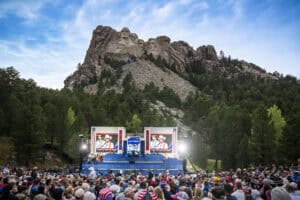

3:00 — Audio & Lighting Move In: Miles of Cable

Once the platform is secured and clear, the technical world—Audio and Lighting—takes over. This phase is characterized by intense, parallel work and the running of miles of feeder cable and signal lines. Line array speakers, which weigh hundreds of pounds, are carefully prepared to be flown (hung) or ground-stacked. Lighting truss is swiftly assembled on the deck. Crucial dimming racks and power distro (distribution) units are placed, connected, and tested for electrical phase compatibility. Communication is at its most critical now: a lighting cable path can’t block a structural rigging point, and a speaker stack cannot sit where a main camera needs to land. Precision planning ensures these dependencies are non-conflicting.

6:00 — Video and Rigging Operations: Going Vertical

The physical ceiling comes to life as the rigging teams execute their dangerous, specialized task. They manage the heavy lifting: flying truss, securing motors, and applying triple safety checks before any substantial weight is loaded. Simultaneously, the Video/LED team begins assembling the massive display—connecting individual tiles, frames, processors, and playback racks. The screens are often built in large sections on the ground before being lifted skyward. This is the ultimate vertical coordination challenge, where the technical accuracy of the video signal lines must align perfectly with the engineering safety of the overhead motors.

9:00 — Backstage & Show Office Setup: The Command Center

While the main stage reaches critical mass, the Back-of-House  infrastructure comes to life. This is the command center of the entire event. Crews set up Producer tables, Comms (communication) systems, Stage Manager stations, Green Rooms, and Teleprompter stands. WiFi drops are strategically placed, and Scenic storage zones are established to keep the stage clear. For top-tier events, the organization and operational readiness of the BOH—the quiet chaos of the production staff—is as complex and essential as the visible show floor.

12:00 — Technical Soft Testing & Power Up

Halfway through the sprint, the infrastructure is mostly complete, and the tech teams move into the vital “soft testing” phase. This is when the systems are truly powered on and tuned. Engineers perform complex tasks like audio tuning and frequency coordination (to prevent microphone interference), lighting focus and color correction, and intricate LED pixel mapping (ensuring graphics display correctly across different screen resolutions). This is often the first moment the event starts to feel real, as the stage illuminates and the first playback video loops begin.

15:00 — Front-of-House: Seating, Décor, & Audience Flow

Focus shifts to the Front-of-House (FOH) area—the audience’s experience. Crews install all audience seating, VIP rows, camera platforms, press risers, and ADA accommodations. Simultaneously, the scenic and décor teams finalize the look: hanging large banners, placing the podium branding, and installing essential signage and entry flow design. The PM maintains constant oversight here, managing all cross-traffic and ensuring no last-minute placement of a chair or banner interferes with previously established cable paths, sightlines, or safety perimeters.

18:00 — The Polish & Client Walkthrough

This is the all-important polishing phase—the rush to perfection. Technicians perform minute adjustments: final podium placement, microphone checks, backline adjustments for talent, and running teleprompter test scripts. The final touches like carpet, drape, and final scenic adjustments are made. The essential Client Walkthrough occurs now. This is where strong project management matters most: questions must be answered immediately, any critical adjustments must be made without delay, and total confidence must be instilled in the client that the stage is ready.

22:00 — Showtime Readiness & Final Checks

The build is essentially complete; the focus shifts entirely to operational readiness. This final two-hour window is dedicated to the ultimate dry run: a full technical rehearsal with talent, a final Comms system test, and last-minute checks of security positioning and seating ushers. The stage manager runs through the entire cue list. From an empty, cavernous room 24 hours earlier to a perfectly lit, fully integrated, show-ready environment, the transformation is now complete. The crew stands by, the doors open, and the audience enters. The true magic, of course, is that the build is now invisible

Vendor Coordination: The Real Backbone of the Build

Building a stage in 24 hours only works when every single vendor—from the scenic carpenter to the lighting programmer—trusts the single leader at the center: the Project Manager (PM). The PM is the general contractor of the event world, transforming dozens of specialized, independent contractors into a single, cohesive unit. Their role is not simply delegation; it is the anticipation and management of dependencies that constantly threaten to derail the timeline.

A PM must be able to hold the entire sequence of the build in their head, coordinating complex, interlocking dependencies such as:

Audio waiting on LED: Speakers cannot be flown until the massive LED wall is secured in its final overhead position.

LED waiting on Rigging: The LED wall, built on the floor, can’t be lifted until the motors and truss are precisely attached and checked by the certified riggers.

Lighting waiting on Staging: Light truss and fixtures cannot be built on the stage floor until the deck is structurally complete and signed off.

Power waiting on Venue Approval: Bringing in heavy-duty generators or tapping into venue power requires multiple sign-offs and must be done before major technical systems can be powered up and tested.

Décor waiting on Cable Paths: Scenic elements must be held back until all essential signal and power cables are run, secured, and safely taped down.

Every decision the PM makes has a cascading domino effect. Every minor error costs valuable time that cannot be recovered. Every stall—even a 15-minute wait for a scissor lift—can compromise the entire show schedule. For expert teams like ESI, their core strength is acting as the central intelligence and command center—managing every moving part until the entire complex machine clicks into perfect sync.

Managing the Chaos: What No One Talks About

The pre-production plan is a masterpiece of theory, but the build site is a harsh proving ground of reality. Even the most perfect plan gets tested instantly onsite. The difference between a smooth opening and outright panic is not the existence of problems, but the quality of the response.

The critical difference between panic and success is Leadership. It requires calm, objective decision-making, the ability to activate backup plans without hesitation, and a team that trusts each other implicitly. Ultimately, it comes down to a Project Manager who has the authority, experience, and speed to make a decisive decision and communicate the new, immediate path to hundreds of people instantly.

Why Clients Choose Teams Who Can Build in 24 Hours

Not every production company can maintain this relentless pace and technical accuracy. When a client selects a fast-build team, they are investing in far more than just speed; they are purchasing reliability, efficiency, and confidence.

Clients choose seasoned event professionals because they offer a unique value proposition:

Speed + Safety: Fast does not mean reckless—it means experienced and efficient. This capability is a testament to thousands of hours of perfected logistics and safety protocols, ensuring the structural integrity of a permanent-level build in a temporary timeframe.

Reduced Venue Rental Costs: Every hour saved on site translates directly into savings on venue rental fees, security, cleaning, and utilities. Shorter build-outs can save tens of thousands of dollars in large convention centers or arenas.

Flexibility for Multi-Day Events: The 24-hour model is crucial for events that require tight, overnight turnarounds—for instance, tearing down a general session stage and building an awards gala set in the same room between midnight and 8:00 AM.

Consistency & Reliability: The ability to execute a 24-hour build consistently is impossible to fake. It demonstrates a level of technical coordination, inventory control, and skilled labor that only the most professional teams possess.

A Partner Who Handles Everything: From the initial structural drawing to the final camera cue and tear-down, the right team brings confidence and singular control. The client knows the technical burden is fully managed, allowing them to focus entirely on the content and their guests.

Conclusion: The Stage Is More Than Wood and Metal

In just 24 intensive hours, the production team achieves a total metamorphosis. An empty, sterile room or open field becomes a dynamic, storytelling platform—a place where global leaders speak, cutting-edge products are launched, history is recorded, and thousands of attendees gather for a shared experience.

It is a transformation powered not by magic, but by planning, precision, and people.

The finished stage is more than wood, metal, and wire; it is the physical manifestation of months of expert planning and a day of flawless execution. And for teams like us at ESI, that transformation isn’t an impossible task—it’s the standard.