

In the demanding world of high-pressure corporate communications and live global broadcasts, relying on “hope” is the most dangerous strategy an organization can employ. When a Fortune 100 CEO steps onto a stage to announce a highly anticipated product, or when a political figure delivers a globally syndicated policy address, there are no “do-overs.” A flickering LED screen, a dropped microphone signal, or a sudden loss of venue power destroys the authority of the moment and inflicts immediate, measurable damage on the brand’s reputation.
Elite technical production teams operate exclusively in a “Zero-Failure” reality. This requires abandoning the assumption that equipment will function perfectly. In the field, hardware fails, software crashes, and cables are accidentally severed. The operational standard is not to prevent all accidents—which is impossible—but to engineer an environment that is entirely “Self-Healing.” This is achieved through the militant application of Redundancy Protocols. The governing philosophy is simple: One is None, and Two is One.
Diverse-Path Routing: The Physical Lifeline The foundation of a redundant system begins with the physical cabling. It is a fundamental error to possess two high-end fiber-optic data lines and run them both through the exact same cable ramp or ceiling conduit. If a forklift severs the conduit, both the primary and backup lines are destroyed simultaneously. That is not redundancy; that is simply duplicate cabling sharing a single point of failure.
True security requires Diverse-Path Routing. The operational map dictates that the “A” line (Primary) and the “B” line (Secondary) take completely different physical geographic routes from the production command center to the stage. The primary fiber might run through the architectural ceiling, while the secondary tactical fiber is taped down along the perimeter wall. If a catering cart crushes the perimeter cable, or a guest trips over a floor line, the primary signal remains entirely uninterrupted. The data flow survives because the physical risk was distributed.
The “Seamless Switch”: Audio and Video Failovers In modern production, the video content—the PowerPoint decks, the high-resolution promotional videos, and the live camera magnification (IMAG)—is driven by immensely powerful media servers. Computers, regardless of their processing power, are susceptible to software crashes.
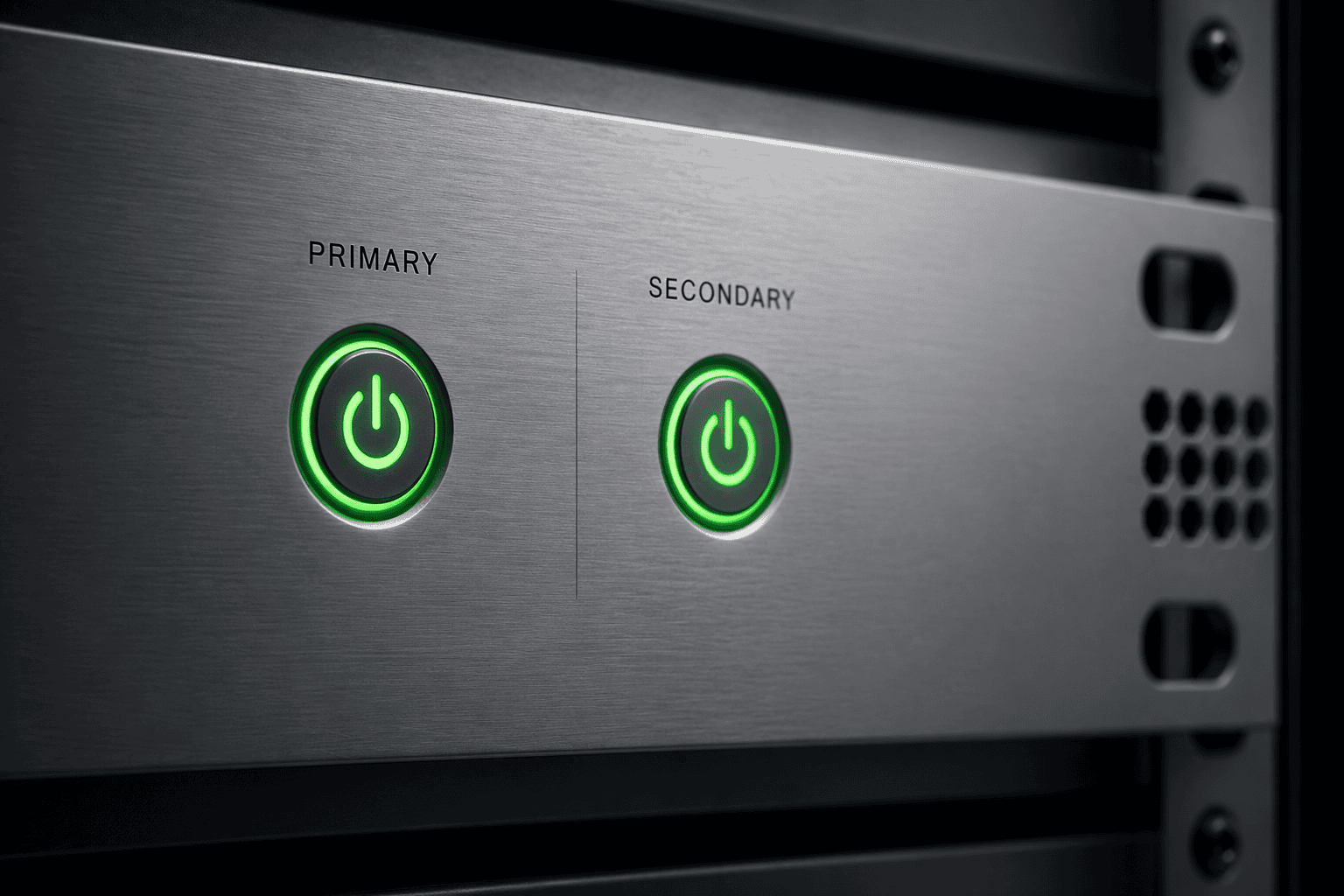
To create a zero-failure visual environment, elite teams deploy two identical media servers running in tandem. The “Primary” and “Secondary” machines are frame-synced using SMPTE timecode, meaning they are playing the exact same video file at the exact same millisecond. Both servers feed into a high-end “A/B” seamless video switcher. If the primary media server experiences a kernel panic or a graphic card failure, the Video Director hits a single button on the switcher. The system instantly pivots to the secondary server. Because the machines are frame-synced, the audience watching the massive LED wall never sees a stutter, a flash of black, or a frozen frame. The transition is completely invisible.
The exact same protocol is applied to audio engineering. High-stakes speakers are never sent to the stage with a single point of failure. They are “Double-Mic’d.” The talent wears two highly discreet lavalier microphones. Each microphone is assigned a different RF (Radio Frequency) channel, transmitting to two separate receivers, feeding into two distinct channels on the digital audio console. If the primary microphone capsule shorts out due to sweat, or the specific RF frequency experiences a sudden burst of local interference, the Audio Engineer instantly unmutes the backup channel. The audience hears a continuous flow of speech, entirely unaware that a catastrophic hardware failure just occurred on the presenter’s lapel.
Power Redundancy: UPS and Auto-Transfer Switches A flawless signal flow is entirely irrelevant if the venue loses power. Municipal power grids fluctuate, transformers blow, and venue breakers trip. An elite production team never leaves the power grid to chance.
Every single mission-critical piece of equipment in the production office and at the Front of House (FOH) control desk is plugged into an enterprise-grade Uninterruptible Power Supply (UPS). These massive battery backups act as a bridge. If the venue power drops, the UPS instantly takes the load, keeping the media servers, audio consoles, and network routers running without a single millisecond of interruption.
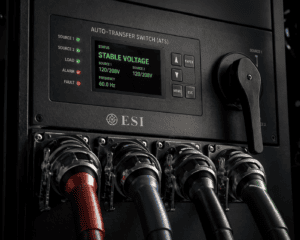
For the heavy infrastructure—the lighting rigs, the LED walls, and the PA systems—the team deploys redundant mobile generators. Two twin-pack generators are staged outside the venue, connected to an Auto-Transfer Switch (ATS). Both generators are running simultaneously. If Generator A experiences a mechanical failure or runs out of diesel, the ATS detects the voltage drop and automatically shifts the entire electrical load to Generator B in a fraction of a second. The lights stay on, the PA continues to push sound, and the broadcast remains live. The venue could plunge into total darkness, and the stage would remain a beacon of uninterrupted power.
The Human Factor: The “Shadow” Crew Hardware and software are not the only elements susceptible to failure; human beings are also a variable. A Lead Video Director or a Master Audio Engineer could experience a sudden medical emergency, extreme fatigue, or an unavoidable personal crisis mid-show. A multimillion-dollar broadcast cannot be halted because one individual is incapacitated.
To mitigate human risk, elite operations deploy a “Shadow Crew” for highly critical positions. A highly trained secondary operator sits adjacent to the primary operator during the live execution. They are intimately familiar with the exact Run of Show, the cue sheets, and the console programming. If the primary operator must step away, the shadow operator seamlessly takes the controls. Furthermore, emergency drills are conducted during technical rehearsals, forcing the team to practice exactly how they will communicate and pivot if a specific crew member “goes down.” Human redundancy is the final layer of the zero-failure protocol.
The Financial ROI of Certainty Building a redundant, self-healing environment requires a larger technical footprint, additional specialized labor, and a significant investment in backup hardware. In the budgeting phase, executives often question the Return on Investment (ROI) of paying for equipment that, ideally, will never actually be used.
The ROI of redundancy is not measured in hardware usage; it is measured in brand protection. The financial cost of a redundant media server or a backup power generator is mathematically insignificant compared to the devastating financial impact of a failed global product launch, the loss of major donor confidence during a botched advocacy keynote, or the viral public relations nightmare of a CEO standing in silence on a dark stage.
Conclusion: The Absolute Guarantee Redundancy is an investment in absolute certainty. Elite technical production requires absorbing the paranoia, the “What Ifs,” and the catastrophic variables so the client never has to consider them.
By engineering diverse-path routing, seamless digital failovers, autonomous power grids, and deep human bench strength, the production environment is completely bulletproofed. The team does not rely on luck, and the team does not rely on the venue. The safety nets are built, the backups are active, and the failovers are armed. That is the uncompromising standard required to guarantee a flawless execution, every single time the lights go down.