
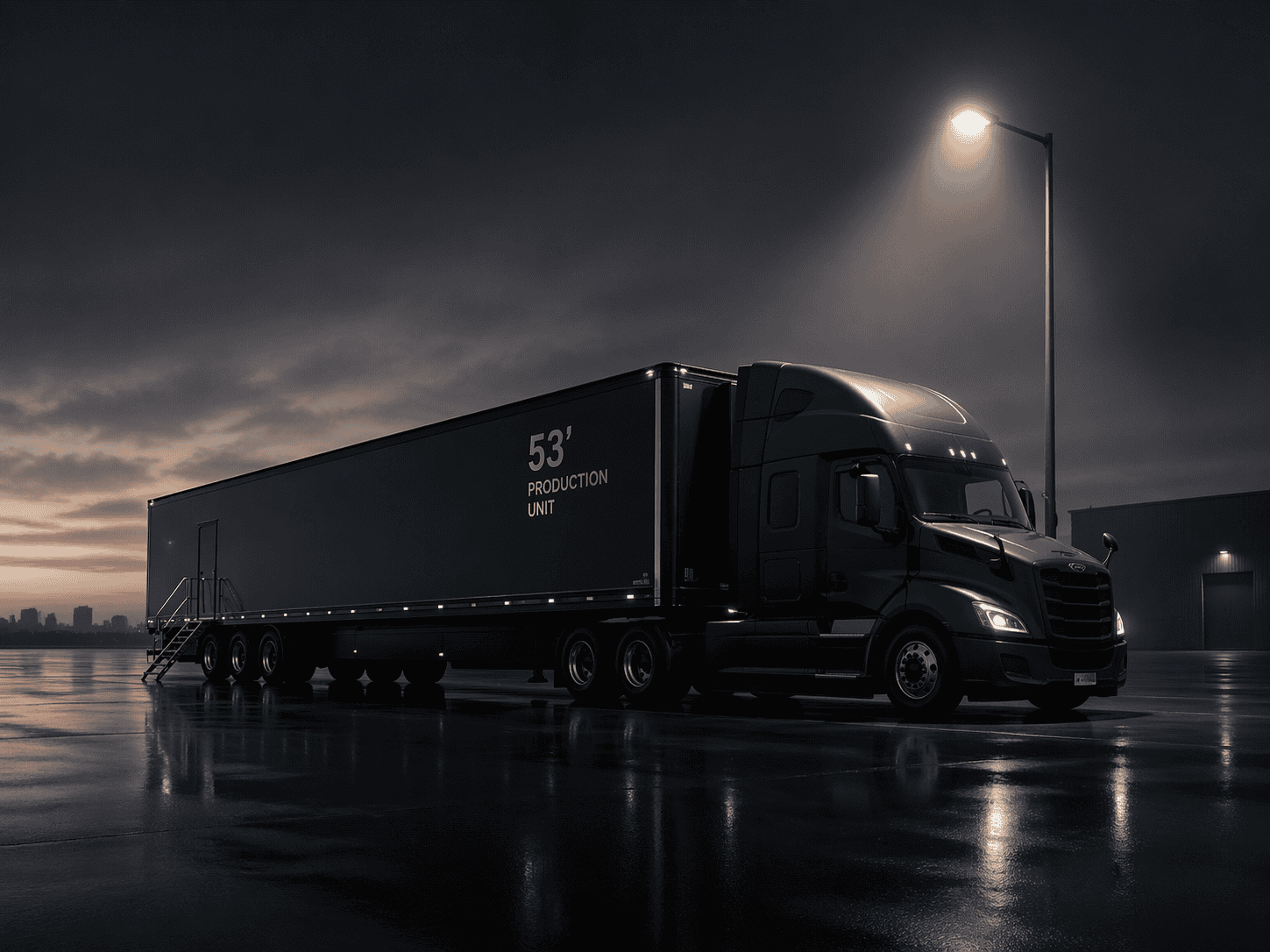

Taking a corporate message or a national advocacy campaign on the road is the absolute pinnacle of live event production. It is a grueling, relentless test of operational endurance. In a standard, single-city event, a technical team has the luxury of time to learn the intricacies of a room, integrate with the local venue engineering staff, and comfortably execute a multi-day load-in. An advocacy roadshow destroys that luxury. The schedule is unforgiving: arrive at 4:00 AM, construct the environment by 10:00 AM, execute a live global broadcast at 2:00 PM, load out the trucks by midnight, and immediately drive 300 miles to repeat the exact same process the next morning.
Executing at this velocity requires a departure from standard event planning. It requires a “Master Blueprint” engineered for total mobility and unshakeable consistency. Elite production organizations do not merely move equipment from point A to point B; they transport a standardized environment of excellence. The objective is to ensure that the broadcast quality and the attendee experience in Des Moines are entirely indistinguishable from the kickoff event in Washington, D.C.
Modular Design and Truck-Pack Engineering The primary hurdle of any roadshow is the “Venue Variable.” Over a ten-city tour, the campaign might transition from a massive indoor hockey arena to an outdoor public park, and finally to a low-ceiling hotel ballroom. To maintain absolute brand consistency across wildly different footprints, the scenic and technical infrastructure must be aggressively modular.
Stage sets, LED video walls, and audio line arrays must be engineered to scale up or down without compromising the aesthetic integrity of the design. A 60-foot wide scenic backdrop used in an arena must be capable of breaking down into a perfectly seamless 30-foot version for a smaller ballroom, utilizing the exact same hardware.
Furthermore, this modularity must serve the god of the road: “Truck-Pack Engineering.” The spatial volume inside a 53-foot commercial trailer is a finite, highly valuable commodity. Every single road case, truss section, and motor must be designed to interlock perfectly within the dimensions of the truck. Elite teams utilize advanced 3D CAD software to map the truck pack before a single piece of gear leaves the warehouse. This ensures the trailer is “weighed out” (balanced properly over the axles for legal transport) and “cubed out” (utilizing every inch of vertical and horizontal space). A flawless truck pack drastically reduces equipment damage during transit and shaves critical hours off the load-in and load-out processes. In a roadshow, speed is currency.
Mobile Infrastructure: The Isolated Grid A fundamental rule of the roadshow is to never rely on the destination’s local infrastructure. When an advocacy campaign visits a remote location or an older municipal facility, the local power grid and internet bandwidth are almost always insufficient for a television-grade broadcast. To eliminate this liability, elite technical teams bring their own isolated grids.
Power generation is treated as an internal utility. The convoy includes twin-pack, “whisper-quiet” towable generators. These units are acoustically dampened so they can operate near the stage without bleeding noise into the broadcast microphones. They provide perfectly clean, true-sine-wave electricity that is completely insulated from the venue’s internal power fluctuations.
Connectivity is handled with identical independence. As established in elite operational protocols, relying on local Wi-Fi or untested venue hardlines is an unacceptable risk. The mobile command center travels with proprietary bonded-cellular networks and mobile satellite uplink capabilities. This mobile fiber-optic equivalent ensures that the production team can establish a highly secure, zero-latency network in the middle of a literal cornfield if the campaign demands it. The environment is venue-proofed.
Endurance Logistics: The Lead-and-Chase Crew Model The most sophisticated hardware on the tour is entirely useless if the human beings operating it are physically broken. A roadshow is a physiological marathon for the technical crew. Managing extreme fatigue is a critical component of risk mitigation. To sustain elite performance over a multi-week tour, production management utilizes advanced “Lead-and-Chase” (or “A and B”) crew models.
Instead of forcing a single technical crew to execute the load-in, run the show, load out, and travel overnight, the labor force is divided into highly specialized, leapfrogging teams. The “Lead” crew (the riggers and master electricians) arrives at City 2 at dawn to hang the heavy steel motors and run the power distribution. Meanwhile, the “Chase” crew (the show operators and broadcast directors) is finishing their required 10-hour rest cycle in a hotel.
Once the heavy infrastructure is built, the Chase crew arrives to program the consoles and execute the live broadcast. As soon as the show concludes, the Chase crew immediately departs for the hotel to sleep, while the Lead crew returns to strike the equipment and load the trucks. This meticulously choreographed rotation ensures that no technician is ever operating heavy machinery or calling a live broadcast while sleep-deprived. Protecting the human engine is the only way to protect the client’s brand.
Municipal Permitting and Advance Work A massive convoy of semi-trucks, sleeper buses, and executive black cars cannot simply pull into a major metropolitan downtown without aggressive, preemptive logistical coordination. The success of a roadshow is heavily dependent on the “Advance Team.”
Months before the convoy arrives, operational leads travel the exact route to secure municipal permits. This involves intense coordination with local city councils, Department of Transportation officials, and local law enforcement. Street closures must be legally secured to park the 53-foot trailers near the loading docks. If the advocacy campaign involves high-profile political figures or a publicized motorcade, police escorts are negotiated to ensure the convoy can move through rush-hour city traffic without fracturing.
The Advance Team physically drives the exact route the transport buses will take from the hotel to the venue, measuring the clearance of bridges, identifying tight turning radiuses, and auditing construction zones. The objective is to absorb all the friction of the city before the principal talent ever arrives. When the convoy rolls in, it moves with the unstoppable momentum of a highly orchestrated military operation.
Standardizing the Broadcast Asset The ultimate deliverable of an advocacy roadshow is the captured media. The live stream, the press photography, and the nightly news b-roll are the assets that drive the campaign’s global narrative. Therefore, the “look and feel” of the broadcast must remain aggressively consistent across all ten cities.
This requires deploying a standardized “Broadcast Bible.” The camera angles, the specific color temperature of the key lighting, the focal lengths of the lenses, and the graphic overlays are locked in stone during pre-production. A viewer watching the livestream on day one should experience the exact same visual authority and sonic clarity as a viewer watching on day twelve.
Furthermore, the press corps traveling with the tour must be accommodated with identical precision at every stop. The press risers must feature the same dimensions, the audio mult-boxes must deliver the same pristine isolated feeds, and the lighting must pop the principal off the background with the exact same contrast ratio. By standardizing the media environment, the campaign’s message is never diluted by a poor technical setup.
Contingency Execution on the Asphalt The road is inherently chaotic. Severe weather cells will ground flights, transport trucks will experience catastrophic tire blowouts on the interstate, and equipment will occasionally fail under the vibration of a thousand highway miles. Elite production is not defined by the absence of problems; it is defined by the speed and invisibility of the solutions.
Contingency planning on a roadshow requires deep operational redundancy. The convoy includes “shadow” vehicles—empty transport vans or backup luxury SUVs traveling with the pack—ready to absorb passengers if a primary sleeper bus breaks down. The truck packs include spare LED tiles, backup digital audio consoles, and redundant cabling.
If a severe winter storm forces the cancellation of an outdoor rally, the production team executes a pre-planned pivot. Within hours, a sterile hotel ballroom in the city is transformed into a “Town Hall” broadcast studio. The modular infrastructure is deployed, the bonded cellular networks are activated, and the principal delivers the message to the global audience without missing a news cycle.
Conclusion: Commanding the Asphalt An advocacy roadshow is the ultimate crucible for an elite technical production firm. It strips away the comforts of a permanent venue and demands relentless, daily perfection in completely foreign environments.
By engineering modular, scalable infrastructure, controlling mobile power and data grids, enforcing rigid crew endurance protocols, and aggressively managing municipal advance work, the operational chaos of the road is entirely neutralized. The logistical friction is absorbed by the production team so the client, the donors, and the principal talent can focus purely on building the movement. The road becomes an extension of the command center, ensuring that the brand’s message is delivered with unshakeable authority, city after city, mile after mile.