
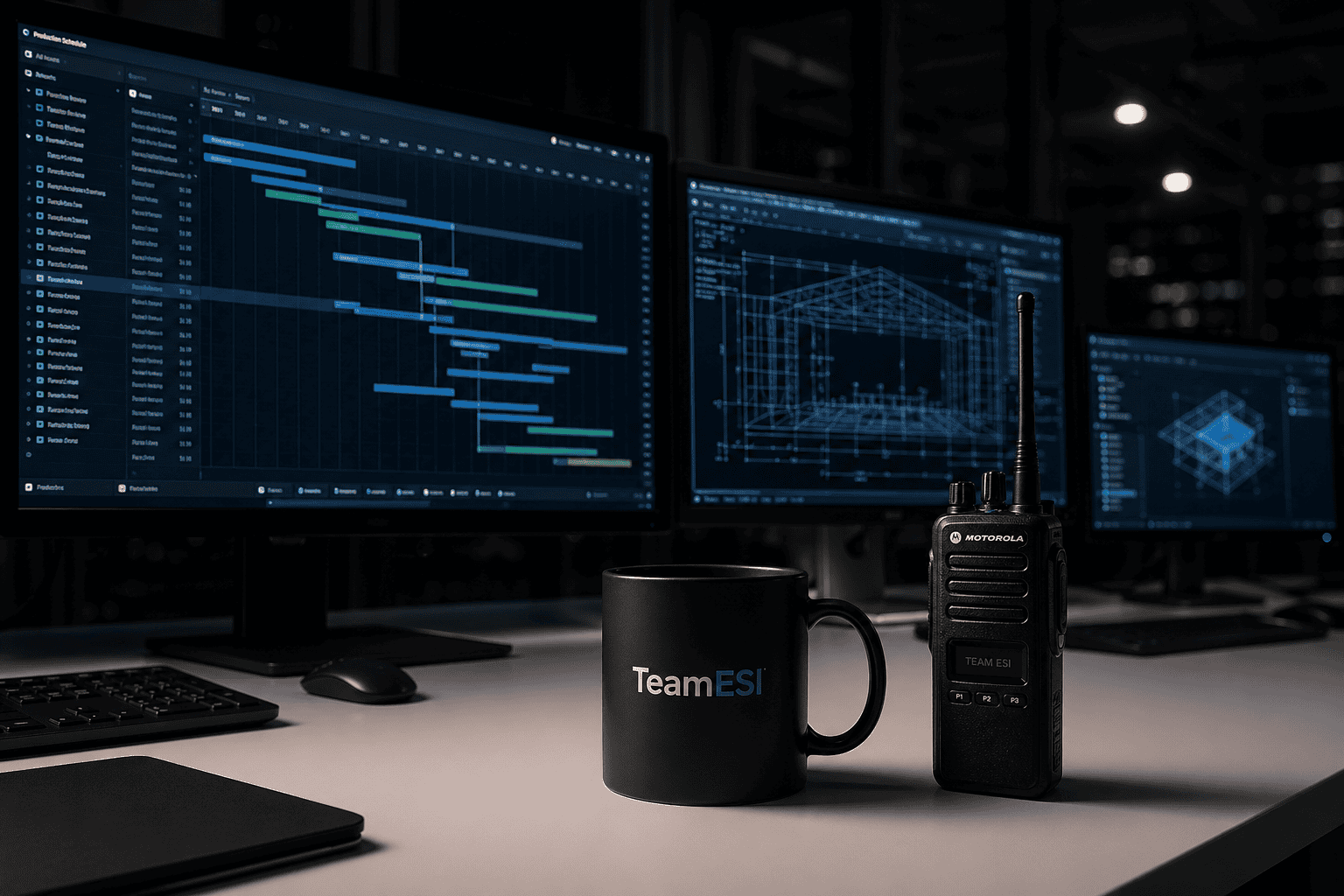

In the execution of a Fortune 100 corporate keynote or a sprawling national advocacy tour, the stage commands the attention of the audience, the media, and the cameras. However, the stage is merely the physical manifestation of the data, decisions, and logistics processed behind closed doors. The true nucleus of any live event is the Production Office.
If the production office is disorganized, the show will inherently be disorganized. Elite technical teams treat the workspace not as a temporary convenience, but as a high-performance command center. Whether the operation takes place in a five-star luxury hotel boardroom, an empty concrete locker room in a sports arena, or a temporary climate-controlled tent in a desert, the operational standard of the command center remains unyielding. Deploying this environment requires a militant focus on infrastructure, data visualization, and psychological focus.
Infrastructure First: Power, Fiber, and Hardware An elite command center cannot function on the venue’s standard amenities. The deployment begins with establishing an independent technological footprint. Project managers, technical directors, and show callers are simultaneously downloading massive 4K video rendering files, updating cloud-based logistical manifests, and communicating via VoIP networks. Relying on a standard wall outlet and the venue’s guest Wi-Fi is an operational liability that will immediately paralyze the team.
The footprint is established by pulling dedicated, isolated fiber-optic data lines directly into the room, creating a secure Local Area Network (LAN) specifically for the production staff. This network is fortified with enterprise-grade firewalls. Furthermore, power distribution is heavily managed. Every workstation is backed by an Uninterruptible Power Supply (UPS). If the venue experiences a localized power surge or a total blackout, the production office must remain fully operational, serving as the illuminated beacon where the emergency response is coordinated.
High-speed, high-capacity laser printers, massive charging banks for the two-way radio fleet, and dedicated secure servers are standard deployments. The hardware brought into the room must be capable of supporting a multi-million-dollar corporate infrastructure, engineered to be unpacked, booted up, and fully operational within sixty minutes of the team’s arrival.
The Common Operating Picture (COP) In a high-pressure, 24-hour build cycle, the most dangerous variable is an uninformed crew member. When project managers are forced to constantly answer repetitive logistical questions, their cognitive bandwidth is drained, and the speed of the operation plummets. Elite teams neutralize this friction by establishing a “Common Operating Picture” (COP).
The COP is a military and emergency-management concept adapted for elite live production. It involves utilizing every available wall space within the production office to visualize the exact, real-time status of the operation. Massive, printed architectural CAD drawings, the Master Run of Show (ROS), highly detailed technical cue sheets, and real-time transportation manifests are mounted on the walls.
When a lighting designer, a transport captain, or a corporate client walks into the production office, they do not need to interrupt a working producer to understand the status of the event. A single glance at the COP provides total situational awareness. If a timeline shifts or a scenic element is modified, the COP is updated instantly with a red marker. This visual data management ensures that a team of fifty to a hundred highly specialized technicians remains perfectly aligned, moving as a single, coordinated organism.
Spatial Layout and Ergonomic Flow The physical geometry of the production office dictates the efficiency of the team. A haphazard arrangement of folding tables creates physical bottlenecks and restricts the flow of communication. The command center is designed with specific functional zones, optimized for the exact operational workflow of the event.
The “Show Control” pod—housing the Stage Manager, the Executive Producer, and the Lead Technical Director—is positioned centrally to allow for rapid, face-to-face decision-making. The “Logistics and Transport” pod is placed near the primary entrance of the office, as these team members must constantly interface with drivers, hotel liaisons, and incoming talent. The “Creative and Media” pod, responsible for rendering video files and processing heavy graphics, is situated in the quietest sector of the room to allow for deep, uninterrupted focus.
Furthermore, ergonomics are never ignored. Expecting a specialized software programmer or a master logician to execute flawless work while sitting on a cheap, rigid banquet chair for eighteen hours is an absurd operational failure. Elite teams travel with, or locally rent, high-quality ergonomic seating and proper desk lighting for the command center. Physical fatigue accelerates mental fatigue; investing in the physical comfort of the workspace directly extends the cognitive endurance of the entire management team.
Data Security and the Sterile Perimeter In 2026, data security is arguably as critical as physical security. A production office for a Fortune 100 brand launch or a political advocacy campaign operates as a clearinghouse for highly sensitive, embargoed information. Unreleased product specifications, confidential financial keynote speeches, and private VIP travel itineraries flow through the command center’s servers and printers.
Therefore, the production office is treated as a secure, sterile perimeter. Access is strictly controlled via credential scanning or dedicated security personnel posted at the door. The network infrastructure utilizes encrypted, hidden SSIDs and strict MAC address filtering, ensuring that no unauthorized devices can monitor the internal traffic.
Documents containing secure information are never left unattended on printers, and “clean desk” policies are aggressively enforced before the team departs for the night. The command center is a vault. The client must possess absolute, unshakeable confidence that their proprietary intellectual property and the personal security of their executives are protected with military-grade precision.
The “Zero-Noise” Zone: Protecting Cognitive Load A live event is an inherently chaotic, high-decibel environment. The loading dock is loud, the main stage during audio tuning is deafening, and the ballroom lobby is highly kinetic. The production office must serve as the absolute antithesis to this chaos. It is a designated “Zero-Noise” zone.
This protocol dictates that the office is not a social lounge, a break room, or a place to hold casual conversations. It is a sanctuary for critical thinking, complex problem-solving, and high-level client negotiations. When a crisis occurs on the floor—a failed motor, a delayed flight, or a corrupted media file—the technical leads retreat to the production office to execute the pivot.
If the room is loud and chaotic, the adrenaline of the crisis is amplified, and poor decisions are made. By enforcing a quiet, intensely focused atmosphere, the command center naturally de-escalates panic. The problem is assessed calmly, the contingencies are reviewed on the Common Operating Picture, and the solution is deployed over the radio network with cold, calculated authority.
Conclusion: The Engine of Execution The quality of a live event will never exceed the quality of the workspace where it was engineered. Elite technical production teams understand that the true battleground is not the stage; it is the spreadsheets, the CAD drawings, the secure networks, and the logistical manifests housed within the command center.
By demanding dedicated infrastructure, enforcing visual data management, securing the digital perimeter, and protecting the cognitive focus of the project managers, the operational friction of a live event is entirely neutralized. The production office becomes an impenetrable fortress of order. When the command center operates flawlessly, the team on the floor executes flawlessly, and the client steps into the spotlight with absolute, undeniable certainty.