

In the high-stakes arena of event-based communications, global brand launches, and national advocacy campaigns, a harsh reality exists: if the media does not capture the shot, the event did not happen. Millions of dollars in capital are routinely invested in custom scenic designs, high-resolution LED walls, and headline talent, only for the press corps to be relegated to a shaky, low-angle platform tucked into the darkest corner of the ballroom. This is a profound failure of operational strategy.
At TeamESI, media operations are approached with the exact same militant technical precision as the primary audio-visual arrays. A press riser is never simply “placed” in a room; an environment is engineered that practically forces the nightly news to lead with the client’s core message. Earned Media Value (EMV) is the ultimate return on investment for any high-profile event. EMV is not generated by hoping the press gets a good angle; it is generated by dictating the environment so perfectly that the press cannot possibly miss it.
The Geometry of the Eye-Level Authority Shot
The foundation of a professional media operation begins with pure geometry. The very first metric calculated is the “Lens Height.” A ubiquitous mistake in standard event planning is deploying a press riser that is either too low—forcing the broadcast cameras to shoot up at the speaker’s chin—or too high, creating a disconnected, surveillance-style bird’s-eye view. The operational objective is the “Eye-Level Authority Shot.”
This requires mathematically coordinating the height of the main stage with the height of the press platform, factoring in the distance between the two. If the main stage is constructed at 48 inches high, and the press riser is positioned 100 feet back in the room, the riser must be built to a specific elevation that allows a long-lens broadcast camera to hit the principal speaker at a perfect, horizontal 90-degree angle.
Furthermore, the “Field of View” must be rigorously audited. During the initial Site Survey, the exact footprint where the camera lenses will live is mapped out. The sightlines are checked for any potential foreground obstructions—decorative floral arrangements, hanging audio arrays, or VIP guest seating—that might creep into the bottom of the broadcast frame. The goal is a clean, unobstructed, branded backdrop behind the speaker that remains perfectly legible even when a network camera is zoomed in for a tight, “head and shoulders” shot. This requires seamless coordination with the scenic department to ensure corporate branding or campaign messaging is positioned exactly where the telephoto lens will find it.
Structural Engineering: The Vibration-Free Deck
A professional press riser must be as structurally sound as a poured concrete floor. When an event attracts twenty still photographers and ten network broadcast cameras—all utilizing high-magnification telephoto lenses—the physics of the platform change entirely. A 400mm lens acts as a magnifying glass for motion; a one-millimeter vibration on the staging deck translates into a massive, unwatchable earthquake on a television screen.
Elite production teams never utilize flimsy, standard-issue staging decks with unbraced legs for a major media operation. Heavy-duty, interlocking deck systems with extensive cross-bracing are mandatory. The architecture of the riser often utilizes a two-tier system to manage the “Surge.” Still photographers, who constantly move, shift weight, and pivot to capture different angles, are placed on a lower, structurally independent tier. Broadcast videographers, whose cameras must remain perfectly locked and still, are placed on a higher, isolated tier behind them. By physically decoupling the two platforms, the kinetic energy from the photographers is prevented from shaking the broadcast cameras.
Capacity planning is also essential. A national advocacy campaign or a high-profile crisis communications event will invariably attract more media personnel than the official RSVP list suggests. The riser must be engineered for maximum surge capacity, ensuring there is enough physical depth for heavy broadcast tripods to sit comfortably without blocking the safety walkway behind the camera operators.
Television-Grade Audio: Mastering the Mult-Box
For the broadcast media, the only thing more important than the visual shot is the audio feed. Providing a “Television-Grade” audio split is an absolute requirement. A network cameraman should never be expected to place a microphone in front of a house speaker to capture the audio. That amateur tactic results in echoing, hollow, unprofessional sound that major news networks will simply refuse to air.
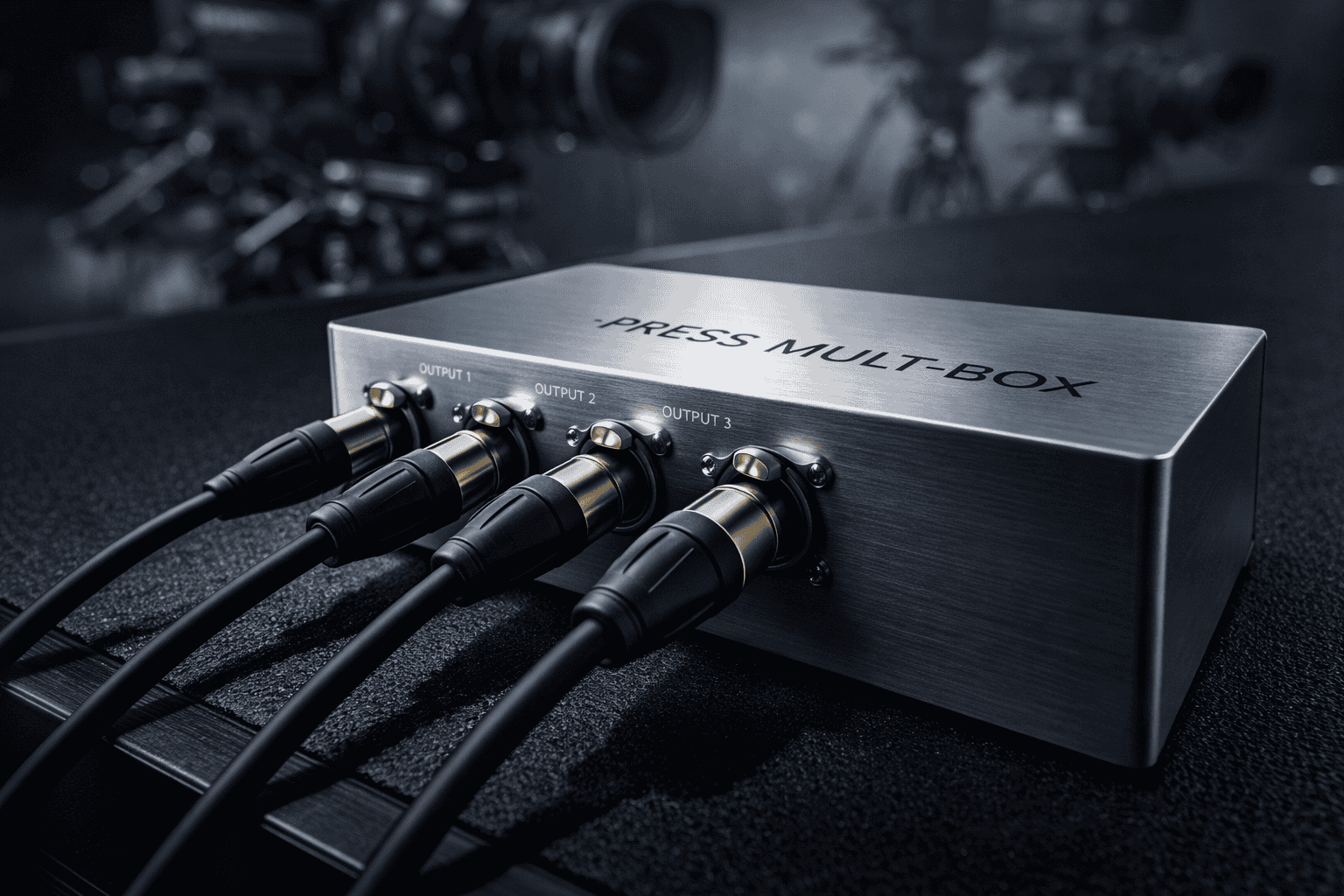
Instead, a clean, isolated audio feed is provided directly from the digital audio console via a Press Mult-Box (Multiple Output Box). The Mult-Box takes a single, pristine line-level audio feed from the production team and splits it into dozens of individual, transformer-isolated XLR outputs. Transformer isolation is a critical technical detail; it prevents “ground loops” and electrical hums that occur when multiple cameras from different networks plug into the same power source.
This leads directly to the requirement of dedicated power infrastructure. Broadcast cameras, field monitors, and the laptops reporters use for filing stories require a substantial amount of electrical energy. A reporter should never be forced to crawl under a banquet table hunting for a standard wall outlet. A dedicated, high-capacity “Power Grid” is built directly into the riser itself, providing isolated 20-amp circuits to every media station to ensure equipment remains fully powered throughout an all-day event.
Lighting for the Digital Sensor: Color and CRI
Stage lighting is rarely understood by standard planners. The stage must not only be lit for the human beings sitting in the ballroom; it must be meticulously lit for the digital sensors inside the broadcast cameras. Human eyes automatically adjust to different color temperatures, but camera sensors do not.
There is a specific color temperature—usually 3200K (Tungsten) or 5600K (Daylight)—that broadcast cameras are balanced to capture. If the stage lighting is “mixed” with natural light pouring in from venue windows, the speaker’s skin tones will appear sickly, orange, or artificially blue on the evening news. Elite lighting designers utilize a strict “Key Light” and “Back Light” strategy to create depth of field, physically “popping” the principal speaker off the scenic background so they do not look flat on television.
The intensity of the lighting, measured in foot-candles, must be high enough that the broadcast cameras do not have to “gain up” (artificially increase their sensor sensitivity). Gaining up creates a grainy, pixelated, low-quality image. Additionally, lighting fixtures must be explicitly positioned to avoid “Lens Flare.” Fixtures are angled so they are never pointing directly into the glass of the press riser lenses. The cameras must capture the brilliance of the event’s message, not the blinding glare of the production equipment.
Dedicated Broadcast Connectivity
In the era of live-streaming and instant social media reporting, the press requires massive amounts of bandwidth to file high-definition video files or execute live “hits” to their respective networks. As established in operational protocols, relying on shared venue Wi-Fi is an unacceptable risk.
A dedicated, hard-wired network infrastructure must be extended directly to the press riser. By dropping dedicated ethernet lines tied to a secure, production-only fiber-optic backbone, the media is guaranteed the upload speeds necessary to broadcast without interruption. Providing static IP addresses and hardline connections eliminates the threat of wireless interference from the hundreds of cell phones carried by the event attendees. When the infrastructure makes it effortless for the media to transmit their stories, the client’s message reaches the global market faster and with higher fidelity.
Media Logistics and the Press Briefing
The most advanced technical infrastructure in the world is entirely useless if the media cannot efficiently access it. Media logistics must be managed with the same “white-glove” standard applied to VIP attendees. The media entrance, credentialing desk, and security sweep protocols must be completely separated from the main guest flow. For a high-security political event or a major corporate launch, media personnel often arrive hours before the doors open to establish their positions.
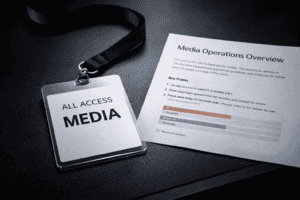
Upon arrival, every media outlet is provided with a “Media Operations Overview.” This is a concise, highly accurate document detailing exactly where the power grids are located, which audio channels the Mult-Box is utilizing, the precise schedule of the Run of Show, and the exact timestamps for when the “Principals” will take the stage. By removing the guesswork from the media’s day, the production team establishes a professional partnership with the networks, directly increasing the likelihood of extended, positive coverage.
Managing the Scrum and Post-Event Coverage
The media operation does not end when the keynote speaker leaves the stage. Following major remarks, there is frequently a demand for a “Scrum,” a press conference, or one-on-one “Pull-Aside” interviews. This secondary phase of the media cycle must be engineered into the floor plan from day one.
A specific “Step and Repeat” or branded interview area is designed adjacent to the press riser. This area allows the media to conduct intimate interviews without the chaotic, distracting background noise of the main room load-out. This secondary space is lit and branded with the same uncompromising precision as the main stage. The background must be clean, the audio must be isolated, and the lighting must be flawless, ensuring that even a quick, five-minute exit interview looks like a million-dollar, studio-grade production.
The ROI of Operational Excellence
Why does an elite production team obsess over the structural cross-bracing of a riser, the transformer isolation of an audio box, and the exact color temperature of a lighting fixture? Because Earned Media Value is the ultimate metric of success.
When a “Winning Shot” is perfectly executed, it generates millions of dollars in free, highly credible advertising for the client. A flawless three-minute segment on a major news network, featuring pristine audio and a perfectly framed brand backdrop, is vastly more valuable than a purchased thirty-second commercial slot. The “Viral Moment”—the confetti drop, the dramatic product reveal, the high-energy interaction with the crowd—is deliberately designed to occur exactly where the camera lenses are mathematically focused. The production team does not merely hope the media captures the story; the stage is built so they cannot possibly miss it.
Conclusion: Dictating the Standard
A professional press riser is the crucial bridge between a live, in-room event and the rest of the viewing world. It is the physical manifestation of a brand’s media strategy. Elite production requires taking that responsibility with absolute seriousness. Providing a platform for cameras to stand is a basic vendor service; providing an engineered environment for a message to go global is a competitive advantage.
By building with unshakeable stability, lighting with digital precision, and managing logistics with operational authority, the team ensures that when the program begins, the signal is clean, the media is empowered, and the resulting shot is legendary. The heavy lifting is executed behind the scenes so the client’s brand can flawlessly take center stage on screens around the world.