
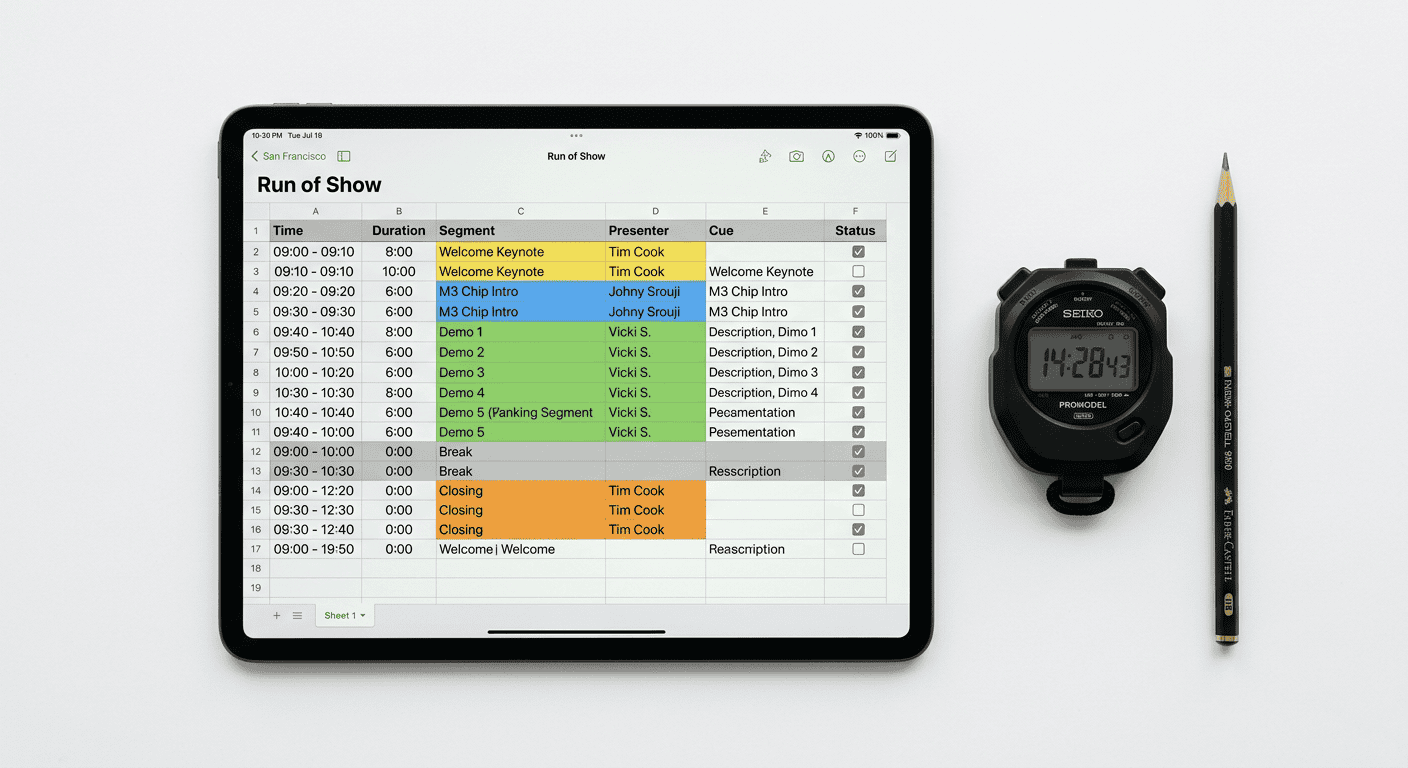

In the high-stakes environment of event-based communications, the stage is far more than a physical platform; it is a high-performance broadcast environment where timing dictates reality. To the audience sitting in the ballroom or watching the global livestream, a flawless event appears completely effortless. The lights shift, the music swells, the video rolls, and the CEO walks out exactly on the crescendo.
However, that illusion of effortlessness is the byproduct of an incredibly rigid, obsessive operational discipline known as Stage Management. It is the critical bridge between a visionary creative concept and flawless technical execution. If the timing of a lighting cue is off by even two seconds, or if a speaker misses their physical mark by three feet, the “magic” of the moment evaporates, and the production value plummets. At TeamESI, stage management is treated as an exact science.
The Holy Trinity: ROS, Script, and Cue Sheets The foundation of any successful live program rests entirely on its documentation. A show cannot be called from memory. Elite production teams utilize what is known as the “Holy Trinity” of event documentation to maintain total control over the environment.
First is the Run of Show (ROS). The ROS is not a general agenda or a rough timeline; it is a minute-by-minute, second-by-second tactical breakdown of the entire event. It dictates exactly when the house doors open, the precise timestamp the “Voice of God” introduction fires, the exact duration of a keynote speech, and the exact moment the walk-out music begins. The ROS is the master clock that the entire crew aligns to.
Second is the Master Script. This document contains the actual spoken word, but it also serves as the emotional map of the show. A highly specialized Stage Manager integrates the script with technical warning cues, ensuring that the audio engineers and lighting designers know exactly which sentence, or even which specific word, will trigger a massive “hero moment” on stage.
Finally, the Cue Sheets. These are the highly technical, department-specific instructions for the Video (V1), Audio (A1), and Lighting (LD) directors. When the Stage Manager—acting as the air traffic controller of the event—calls a specific cue number over the radio headset, every department executes their respective command simultaneously. This level of synchronized, networked execution is the only way to deliver a true, television-grade experience.
Show Blocking and Kinetic Movement Amateur productions simply point a speaker toward the stairs and tell them to walk to the center. Elite stage management involves rigorous show blocking. Every single physical movement on the stage is mapped and choreographed.
During rehearsal, every speaker is walked through their physical “marks”—the exact coordinates on the stage floor where they must stand, how they must enter, the path they must walk, and how they must exit. This is not about micromanaging talent; it is about engineering the broadcast. The Lighting Designer creates a specific “Key Light” focus for that exact mark on the floor. If the speaker stops three feet short of the mark, they will be standing in a shadow, ruining the broadcast shot.
Eyelines are also meticulously mapped. The talent must know exactly where the primary broadcast camera is located, where the confidence monitors (teleprompters) are positioned, and where they should direct their attention to command the room. By removing the “guessing game” of where to stand and where to look, the talent’s anxiety plummets. They are free to focus entirely on the delivery of their message, projecting maximum authority to the audience.
The Voice of God (VOG): Structuring Authority A professional show requires a deeply professional sonic structure. Elite productions utilize Voice of God (VOG) talent—professional voice-over actors—to provide the necessary structure and authority the room demands.
A VOG announcement serves a much higher operational purpose than simply reading a name off a card. It is a psychological tool used to control the energy of the crowd. A booming, pre-recorded, or live VOG introduction signals to the audience that the room is in the hands of seasoned professionals, demanding immediate attention. Furthermore, VOGs are used to seamlessly bridge the gap between speakers, completely eliminating the friction of awkward “handoffs” or dead air while a podium is swapped. By scripting these announcements with mathematical precision, the production team ensures that the program never drags and the transitions remain constantly dynamic.
The Technical Rehearsal: Pressure-Testing the Pulse The philosophy is absolute: the show is won or lost during the rehearsal. An elite stage management team does not conduct casual “walkthroughs”; they execute full-speed, high-pressure technical rehearsals. This is the critical environment where the team intentionally stresses the system to identify and eliminate friction points.
During a technical rehearsal, every single video clip is rolled to completion to verify audio sync. Every slide transition is tested from the clicker on stage. Every microphone frequency is tested for interference. If a video package takes three seconds too long to load on the media server, creating a brief moment of black on the LED wall, that latency is identified and the file is re-rendered during rehearsal, not during the live show.
Furthermore, the team practices “Contingency Execution.” The Stage Manager drills the crew on the “unforeseen.” What is the protocol if a speaker ignores the countdown clock and goes ten minutes over their allotted time? What is the exact sequence if a keynote presentation file becomes corrupted seconds before they walk on stage? The Stage Manager is trained to pivot the entire crew in real-time, holding “backup tracks” and “filler content” ready to deploy at a moment’s notice. This engineered redundancy ensures that the audience never sees the “seams” of the production, no matter what occurs behind the curtain.
Managing the Principal’s Psychology: The Final 60 Seconds The final, and perhaps most delicate, aspect of stage management is the psychological management of the talent in the sixty seconds before they step into the lights. For a national advocacy campaign leader or a corporate executive, stepping out in front of thousands of people is a high-adrenaline event.
A dedicated “Backstage Lead” remains physically with the talent in the secure holding area right next to the stage. This lead ensures the talent’s lavalier microphone is perfectly secured, their water is staged exactly where they want it on the podium, and their clicker is tested and active. The lead projects an aura of absolute, unshakeable calm. By absorbing all the technical and logistical anxiety, the stage management team provides the talent with the ultimate luxury: the ability to clear their mind and focus purely on the win.
The Conclusion: The Invisible Hand of Execution A master Stage Manager operates as the invisible hand that guides the entire event from the opening cue to the final load-out. They are the calm voice on the radio network cutting through the chaos, calling the cues that bring a multimillion-dollar environment to life.
At TeamESI, the show is not merely watched; it is commanded. The programming, the cueing, the show blocking, and the talent management are handled with an uncompromising standard of technical precision. The pulse of the show is engineered so perfectly that every moment feels intensely intentional, every transition feels incredibly seamless, and the client’s message is delivered with absolute, undeniable authority.